


Most bowls sold as ramen bowls are too small for ramen. A typical bowl in a Japanese ramen shop holds 42 to 47 fl oz (1,250 to 1,400 ml) filled to the rim. Plenty of bowls sold online for ramen stop at 28 oz, which puts the broth at the lip and leaves nowhere for the egg to go.
The listing is the second problem. Width gets all the attention, but it tells you very little. In our own range, three bowls listed at 8.5 inches across hold 40.6, 50.7, and 53.4 fl oz.
We sell ramen bowls from Tokyo, so keep that in mind as you read. Every pick here is a bowl we stock, and the sizes are the makers' figures. We judged them on capacity, shape, care, and price. After the picks, you'll find a size chart by ramen style, the Japanese names for each shape, and what the patterns on the rim mean.
The 12 best ramen bowls at a glance
Where a maker gives no capacity or width, the table says so. We'd rather leave a gap than guess.
| Bowl | Best for | Capacity | Width × height | Care | Price |
|---|---|---|---|---|---|
| Indigo Dye Dragon | Best overall | 43.9 fl oz (1,300 ml) | Not listed | Dishwasher, microwave | $49 |
| Ancient Fukumoji | Bold graphic look | 43.9 fl oz (1,300 ml) | Not listed | Hand wash to be safe | $49 |
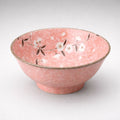
| Mino Pink Sakura | Best budget bowl | Not listed | 8.5 × 3.3 in | Dishwasher, microwave | $29 |
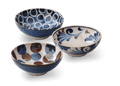
| Brush Blue set of 3 | Best value set | 50.7 fl oz (1,500 ml) | 8.5 × 3.1 in | Dishwasher, microwave | $49.90 |
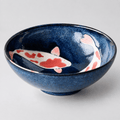
| Nishiki Goi set of 3 | Customer favorite | 53.4 fl oz (1,580 ml) | 8.5 × 3.1 in | Hand wash to be safe | $59 |
| Red Dragon | Classic shop look | Not listed | 8.5 × 3 in | Hand wash to be safe | $59 |
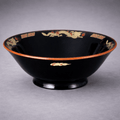
| Black Dragon | Big, loaded bowls | Not listed | 9.6 × 3.5 in | Hand wash | $59 |
| Midnight Zen | Tonkotsu | Not listed | 7.5 × 3.5 in | Hand wash, no microwave | $59 |
| Shirokessho | Clear shoyu and shio | Not listed | 7.8 × 3 in | Dishwasher | $59 |
| Celadon Green | Any soup | 50.7 fl oz (1,500 ml) | 9.1 × 3.5 in | Hand wash | $59 |
| Ryū-mon Dragon | Deepest pick | Not listed | 8.7 × 4.3 in | Hand wash | $59 |
| Akae Tachibana | Best gift | 38.8 fl oz (1,150 ml) | Not listed | Dishwasher, microwave | $99 |
The best ramen bowls for everyday use
If you only buy one bowl, make it the Indigo Dye Dragon Noodle Bowl. At 43.9 fl oz (1,300 ml), it sits inside the range of a Japanese shop bowl. It's porcelain, it goes in the dishwasher and microwave, and the matching spoon and gift box are included. At $49, nothing else on this list covers as much.

The Ancient Fukumoji is the same size and price, with panels of old characters for blessings, happiness, and longevity. Choose it if a dragon is more decoration than you want on the table.

The best budget ramen bowls and sets
For a single bowl under $30, take the Mino Pink Sakura. At 8.5 inches wide and 3.3 inches high, it has the proportions of a full ramen bowl, although the maker gives no capacity. It's a cheerful pink bowl with cherry blossoms, and it can go in the dishwasher and microwave.

Feeding more than one person? The sets are better value. The Brush Blue set works out at under $17 a bowl for three different indigo patterns, each holding 50.7 fl oz (1,500 ml). The Nishiki Goi set is our most-ordered ramen bowl product, with red and white koi on a deep indigo inside. Both are wide and fairly low at 3.1 inches, which gives toppings plenty of room. They are also generous enough for curry, pasta, and big salads.


The best classic ramen shop bowls
Some people want the bowl they remember from the counter: a red spiral around the rim and a dragon at the bottom. The Red Dragon is that bowl. Its Japanese trade name calls it a 7.0 tamadon, a size and shape you will find in working ramen shops. It has a white body, a red and gold dragon medallion in the center, and a band of flowers. It's high-gloss porcelain, made in Aichi rather than Gifu.
The Black Dragon is the single ramen bowl our customers order most. At 9.6 inches wide, it is also the biggest bowl here. Use it for heavily loaded ramen, and measure your shelf first. Its gold decoration means hand washing and no microwave.


The best ramen bowls by soup
Japanese shop suppliers have a simple rule of thumb: white or celadon suits any soup, while black and red suit miso, shio, and tonkotsu. A dark bowl makes a white soup stand out. A pale bowl lets you see the color of a clear one.
Tonkotsu
Tonkotsu shops often use smaller bowls, because Hakata-style customers order a refill of noodles, called kaedama, instead of one large serving. The Midnight Zen follows that logic. At 7.5 inches (19 cm), it matches the 6.3-sun bowls those shops favor, and its black glaze sets off a milky broth.

Shoyu and shio
Clear soups need a light background. The Shirokessho has a soft matte white surface with a silver band at the rim, and the listing says it can go in the dishwasher. The Celadon Green is larger, at 9.1 inches and 50.7 fl oz (1,500 ml), with a white arabesque pattern on a soft jade glaze.


Miso and thick soups
Miso ramen carries a lot on top: corn, butter, bean sprouts, ground pork. Depth keeps that from spilling when you stir. The Ryū-mon Dragon stands 4.3 inches high, the deepest bowl we picked, and that height also suits donburi and simmered dishes.

The best ramen bowl for a gift
A ramen bowl is a good gift because few people buy a proper one for themselves. The Akae Tachibana is the one to give. Its square shape is unusual, its red and green floral pattern is striking, and it arrives in a gift box with a matching spoon. It's practical too: the bowl and spoon can both go in the dishwasher. Choosing for a tea drinker instead? See our guide to gifts for tea lovers.

How big should a ramen bowl be?
Aim for 40 to 47 fl oz (1,200 to 1,400 ml). Here's the math. A generous home serving is about 2 cups (475 ml) of broth, plus cooked noodles and toppings. Together, that comes to roughly 30 fl oz (900 ml). A bowl works best about three-quarters full, which leaves room to stir, lift the noodles, and carry it to the table. So you need around 40 fl oz before you think about the pattern.
| What you make | Capacity | Width | Try |
|---|---|---|---|
| Instant ramen, lighter bowls | 32–40 fl oz (950–1,200 ml) | 7.5–8 in | Kinsai Hanabi |
| Everyday shoyu, shio, or miso | 40–47 fl oz (1,200–1,400 ml) | 8–8.5 in | Indigo Dye Dragon |
| Tonkotsu with a noodle refill | About 30 fl oz (900 ml) | About 7.5 in | Midnight Zen |
| Loaded bowls, big appetites | 50 fl oz (1,500 ml) or more | 8.5–9.5 in | Brush Blue set |
| Tsukemen | Two pieces: a wide plate and a small dipping bowl | About 6 in for the dip | Jukusa bowl |
Why width alone tells you so little
Depth and wall angle do as much work as the rim. The Kuro Cloud Swirl, the Brush Blue set, and the Nishiki Goi set are all listed at 8.5 inches, yet there is a 12.8 fl oz (380 ml) gap between the smallest and the largest. Japanese kitchen suppliers make the same point: one extra centimeter of width can add several hundred milliliters.
Japanese suppliers size bowls in sun, an old unit of about 1.2 inches (3 cm). Most ramen bowls run from 6.3 to 7.0 sun, or roughly 7.5 to 8.3 inches. If you see a number like 6.8 or 7.0 in a Japanese product name, that is what it means, although the exact width still varies by maker. Check the centimeters.
Shape and material matter too. Our guide to choosing a ceramic ramen bowl goes through both.
Ramen bowl shapes and their Japanese names
The trade sorts ramen bowls into a few standard shapes.
| Shape | What it looks like | Why choose it |
|---|---|---|
| Sori-kodai (反高台丼) | Tall foot, rounded body, flared rim | The standard. About half of well-ranked Japanese shops use it, usually around 6.8 sun, holding 42 to 47 fl oz to the rim. |
| Kiritate (切立丼) | Straight walls, low profile | Easy to hold and stack. Around 6.3 sun and 30 fl oz (900 ml), and a favorite of shops serving noodle refills. |
| Tamadon (玉丼) | Round body, thick rolled rim | The thick rim resists chipping. It suits ramen with many toppings and chanpon, and it is common in Hokkaido. |
| Tayodon (多用丼) | Plain, all-purpose curve | Works for ramen, udon, soba, and katsudon. Small versions make good tsukemen dipping bowls. |
For more detail, read our guide to ramen bowl types and materials. If you are weighing a ramen bowl against a rice bowl, see the donburi bowl and our notes on Japanese rice bowls.
What the patterns on ramen bowls mean
Most classic ramen bowl patterns came from China, like ramen itself, and each one carries a meaning.
- Raimon (雷文): the square spiral around the rim represents lightning. It has been used in China for around 3,000 years, tied to rain, good harvests, and warding off evil. It has nothing to do with the naruto fish cake swirl.
- Dragon: linked to rain and imperial power, and once reserved for the emperor.
- Phoenix: a bird of good fortune, with the male and female standing for the emperor and empress.
- Double happiness (双喜): two joined characters for happiness, used at weddings and celebrations.
Warm the bowl first
This one habit does more for your ramen than any bowl we sell. Fill the bowl with hot water from the kettle, leave it for a minute, then empty and dry it before the broth goes in.
By our rough math, a 1.1 lb (500 g) bowl at room temperature pulls about 23°F (13°C) out of 17 fl oz (500 ml) of steaming broth within moments. That's an estimate, not a lab test, but you'll notice it. It also matters more than material. Nearly every bowl here is porcelain, the standard in Japanese shops, and we would not pay extra for claims that one ceramic holds heat far better than another.
Check the listing before pouring near-boiling water into a piece with metallic decoration or a note about sudden temperature changes. Warm those bowls gradually with hot tap water.
Get a spoon that fits

Buying guides rarely mention spoon length. The usual advice from Japanese suppliers is at least 6.7 inches (170 mm) for a standard flared bowl and about 6.3 inches (160 mm) for a small straight-walled one. Shorter spoons slide into the broth. Longer ones look oversized. More on this in our article on the ramen spoon. A chopstick rest keeps the table clean, too.
What to avoid when buying a ramen bowl
- Bowls under 30 fl oz for full ramen. They work for rice or a side of soup, but noodles and toppings will crowd the broth.
- Treating listed capacity as serving size. The figure runs to the rim. Plan to use about three-quarters of it.
- Forgetting your cupboard. A 9.6-inch bowl can be too wide for a shelf or dishwasher rack. Measure before you buy.
- Microwaving gold or silver. Metallic decoration doesn't belong in a microwave, whatever the bowl. Our guide to microwaving Japanese pottery explains why.
- Assuming all ceramics are alike. Buy from a seller who can tell you where a bowl was made. Over half of Japan's ceramic tableware comes from the Mino area of Gifu, and most of our picks do too. Read what Mino ware is and whether Japanese pottery contains lead if you want to know more.
What to put in your new bowl
Our guide to what to put in ramen covers toppings. If you learn one thing first, make it ramen eggs. And if tonight's dinner is a packet of instant noodles, these fixes will still help. For the wider picture, start with our guide to Japanese tableware.
Browse all Japanese ramen bowls
Frequently Asked Questions
What kind of bowl is best for ramen?
A porcelain bowl with a wide, flared rim that holds about 40 to 47 fl oz (1,200 to 1,400 ml). That shape leaves room for toppings and gives you space to lift the noodles.
What size is a standard ramen bowl?
A standard Japanese ramen bowl is about 8 to 8.5 inches (20 to 21.5 cm) wide, or around 6.8 to 7.0 sun, and holds 42 to 47 fl oz to the rim. Small tonkotsu bowls are closer to 7.5 inches and 30 fl oz.
How many ounces should a ramen bowl hold?
For a full home serving, look for at least 40 fl oz. A smaller bowl of 32 fl oz is fine for instant ramen. Remember that listed capacity runs to the rim, so you will use about three-quarters of it.
Are porcelain or ceramic ramen bowls better?
Porcelain is a type of ceramic, and it is the standard in Japanese ramen shops because it is dense and durable. Stoneware looks earthier. Warming the bowl first makes a bigger difference to your soup than the material does.
What is the difference between a ramen bowl and a donburi bowl?
A donburi bowl is built for rice with a topping, so it is usually smaller. A ramen bowl needs extra room for broth. A large donburi can work for ramen if it holds about 40 fl oz.
Can ramen bowls go in the dishwasher and microwave?
Many porcelain bowls can, but check each listing. Bowls with gold or silver decoration should stay out of the microwave, and some glazes need hand washing.