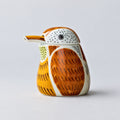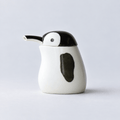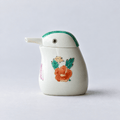



He was painting a lid no bigger than a large coin. Seated cross-legged behind a low wooden board, he turned the porcelain in one hand and held a long, pink-handled brush in the other. The green on its tip was pale and chalky. Beside him, a newspaper-lined wooden box held small dispensers and lids in glossy red, blue and green.
This was the final visit of our June 2026 day following how Arita porcelain is made. After the clay works, forming workshop and main kiln, we had come to a home studio near Kami-Arita station to understand another stage: overglaze painting. Our host told us he had been painting for about seventy years. I asked most of the questions in Japanese.
What is overglaze painting?
Overglaze painting is decoration applied to the surface of already glazed and fired porcelain, then fixed in an additional, lower-temperature firing. In Arita, the technique is called uwa-etsuke (上絵付け). The term aka-e (赤絵) is also used for overglaze color decoration, particularly palettes in which red plays a leading part.
It is an extra stage after the main glaze firing, often the third firing if the earlier bisque firing is counted. Some colors or metallic finishes require further firings. In our host's studio, the overglaze firing was around 800°C (1,470°F), compared with about 1,300°C (2,370°F) for the main firing. These were the temperatures he described for his work, not a fixed recipe for all Arita porcelain.
A finished blue-and-white piece can therefore return to a painter's board. Red, green and other enamel colors add a new layer of decoration. Gold, where used, belongs to this later stage too.
Why Arita porcelain is also called Imari
The names overlap because of trade. Much of the porcelain historically shipped through Imari port was made in Arita and neighboring production areas. In English, Imari can also describe a decorative export tradition, often combining underglaze blue with overglaze red and gold. It is not a guarantee that every piece has the same palette or production method.
Ko-Imari, or Old Imari, is used for historical wares; modern Arita porcelain in an Imari-inspired palette is not an antique. Today, Imari ware can also refer to ceramics produced in Imari itself. The Ashmolean Museum's export porcelain glossary distinguishes Imari as a port from Imari as a category of enamelled ware.
Overglaze porcelain was being made in Arita by the 1640s, according to the Japan Tourism Agency's account of the Kyushu Ceramic Museum's Arita history. For the wider story, read our introduction to Arita ware.
Underglaze and overglaze: where the color sits
The difference is easiest to understand as a sequence. Sometsuke blue is painted before the transparent glaze is applied and high-fired. Overglaze enamel is added afterward. A single piece may combine both.
| Stage | Underglaze blue: sometsuke | Overglaze: uwa-etsuke / aka-e |
|---|---|---|
| Painting surface | The unglazed body, commonly after bisque firing | The already fired glaze surface |
| Typical decoration | Cobalt-blue designs made with gosu pigment | Enamel colors such as red, green and yellow; metallic decoration may be added separately |
| Firing sequence | Fired with the glaze in the main high firing | Fixed in an additional firing at a lower temperature |
| Finished surface | The blue is beneath the glaze | The decoration is on the glaze surface and may have a perceptible edge |
| Care | The glaze protects the decoration | Care depends on the enamel and finish; metallic details need particular attention |
We followed the earlier stage in our visit to an Arita kiln for painting, glazing and firing. Here, the white porcelain arrived from another workshop, already glazed and fired. Our host's work began with the color.
Seventy years at the painting board
When I asked how the industry had changed, he answered with a thought about design. Ceramics colleges and design schools had moved on, he said, while many of his patterns were old ones. He did not see that as a reason to abandon them. In translation: “With pottery design, a little slow is just right.”

He showed us thin washi practice sheets that he said dated from his early training. In the apprenticeship he remembered, beginners could spend three to five years practicing lines before being trusted with porcelain. What mattered was senbi (線美): the beauty of the line. A good brush, he told us, was essential to getting it right.
There was an illustrated painting manual dated Meiji 20, or 1887, which he described in relation to Hokusai's style. Earlier readers had written their names at the back. He explained that such books had once been lent for a fee. He still studied Hokusai, and spoke with regret of never having visited the Louvre.
These details made the old patterns feel less like a fixed repertoire than something he was still looking at, comparing and learning from.
A specialist trade, and a family history
Overglaze painting has a long history as a separate occupation in Arita. The Imaemon kiln's glossary records eleven licensed aka-e-ya, later sixteen, gathered under Nabeshima-domain protection in Akae-machi during the Kanbun era (1661–1673). The name means the overglaze painters' district.
The Arita History and Folklore Museum's bulletin No. 132 (Japanese PDF) describes the small overglaze kilns once installed inside painters' workshops. Wood was used into the early Showa period; electric kilns are now common.
Our host's own account reached back further. He said family papers traced sixteen generations to Korean craftspeople brought to Japan by the Hirado domain after the invasions of Korea in the 1590s. The region's Korean ceramic heritage is documented in the Mikawachi ceramics association's history. His family's particular genealogy, however, is his account; we have not independently verified those records.
Some Arita makers employ painters within their own workshops. Others rely on independent specialists. Our host was clear about his place in that network: “I can't make the pieces. I paint them.” It is another part of the division of labor we saw in Arita's forming workshops.
Painting the small pieces of everyday life
He now preferred smaller work: soy sauce dispensers, mugs and little plates. Large vases had become too tiring. At the board, the scale was intimate. A lid could be turned between his fingers while the brush followed its curve.

His subjects were usually plants and flowers, rather than people. He spoke about autumn motifs and the importance of the seasons in Japanese taste. Rabbits and herons, he suggested, had entered the porcelain vocabulary partly because painters saw them around them. These were his reflections on choosing a motif, rather than a rule that explains every historical design.


He also painted with a customer in mind. In his experience, Tokyo buyers often preferred restraint, while Kyoto customers wanted brighter decoration. Even department stores in the same city could have different tastes. He had traveled to Tokyo as a salesman for years, and remembered sellers bringing photographs of motifs they wanted him to interpret.

The additional firing: around 800°C in this studio
After painting, the pieces needed another firing to fix the decoration to the glazed surface. Our host described firing his colors at around 800°C. The lower temperature allows suitable overglaze materials to develop and bond to the surface after the body and main glaze have already matured.
He talked as much about moisture as temperature. During the rainy season, he said, he would preheat the empty kiln for hours to drive out dampness before loading it. Some days he decided not to fire. Dry autumn and winter weather suited his working rhythm better.
This was his studio practice. Enamel composition, drying, kiln design and firing schedule vary, so his account should not be treated as a technical firing guide for another workshop.
What happens when a painter retires?
He told us he had no successor. His children and grandchildren understood how demanding the work was. In his view, the obstacle was not simply access to art schools, but earning a living from the time and concentration this kind of painting requires.
Several people we met that day spoke of the distinctiveness of his work. Their concern was personal as well as practical: how do you pass on decisions that have become almost instinctive? Much of what he knew, he said, had never been written down.
He was still painting almost every day. As a young man, he remembered, his brushwork had been bolder. Now he took more care. Watching him, the value of the work was in those decisions: how much color the brush held, where the line turned, and when to stop.
How to look closely at overglaze porcelain
A few observations can help you ask better questions when choosing a piece. None is a reliable test of hand painting on its own.
- Look at the surface in angled light. Enamel may have a slight edge or a different sheen from the surrounding glaze. That can suggest overglaze decoration, but it does not establish how the design was applied.
- Follow the line. Changes in width, density or brush direction can reveal handwork. Transfers and decals can also vary, and hand-painted work can be very consistent.
- Separate technique from appearance. Red is not proof of hand painting, and a raised design is not proof of brushwork. Overglaze decoration can be painted by hand or applied using other methods.
- Ask about the maker and finish. A named workshop, a clear description of the decoration method and specific care instructions tell you more than broad claims such as “artisan quality.”
Caring for enamel and metallic decoration
Care belongs to the individual piece, not to the color alone. Some contemporary enamel-decorated porcelain is rated for dishwasher use; other pieces need hand washing. Follow the maker's instructions.
For delicate decoration, use a soft sponge and mild detergent, avoid abrasive pads, and protect decorated surfaces when stacking. Keep porcelain with gold, silver or other metallic decoration out of the microwave unless the manufacturer expressly confirms that the particular piece is suitable. Our ceramic care guide covers washing and storage in more detail.
For another Japanese tradition associated with overglaze color, explore Kutani ware.
Three Arita pieces to look at more closely
We have chosen a small selection for the way their colors and forms relate to this story. These are contemporary pieces from other makers, not work by the painter we visited. The workshop photographs document his practice; they do not establish how the shop pieces were produced.
Sometsuke Akae Harmony Bowl
The Sometsuke Akae Harmony Bowl combines an indigo ground with red and yellow accents across a lidded form. Our product description identifies hand-painted decoration and recommends hand washing. It is a useful choice for someone drawn to the meeting of blue and warmer colors, rather than an all-white table setting.

Imari Plum Ribbon Donburi Bowl with Lid
The Imari Plum Ribbon Donburi Bowl takes a more graphic approach: a red ribbon with white plum blossoms crosses blue wave and geometric patterns. Its 16.7 cm diameter gives the design room to unfold across the lid and body. The listing describes hand-painted Imari-style decoration; the piece is modern, rather than Old Imari.

Kobana Stripe Soy Sauce Dispenser
The Kobana Stripe Soy Sauce Dispenser brings the subject back to the small everyday object on our host's board. Red stripes and green and yellow accents give it a different character from the floral dispensers in his studio. We include it as a related Arita design; its listing does not establish that it uses his painting method. Hand washing is recommended.

Browse our Japanese soy sauce dispensers or the wider Arita ware collection.
Follow the series: how Arita ware is made
- From Amakusa stone to porcelain clay: selecting and refining the body.
- Shaping Arita porcelain: the role of plaster molds and specialist forming workshops.
- Painting, glazing and firing: underglaze blue and the main kiln firing.
- Overglaze painting: the additional color stage, explored here.
Our guide to Japanese pottery styles places Arita alongside other regional traditions.

Thank you to our host for letting us sit beside his board and ask questions. In a shop, the decoration can be taken in at a glance. In his studio, it arrived one small lid at a time.
Sources and author
This feature is based on our June 2026 studio visit, interview and original photographs. Quotations are translated from Japanese. Statements about the painter's training, family, customers and working methods are attributed to his recollections; they have not all been independently verified. Historical context was checked against:
- Imaemon: glossary of Arita porcelain terms (Japanese), including aka-e, aka-e-ya and uwa-etsuke.
- Arita History and Folklore Museum, bulletin No. 132 (Japanese PDF), on overglaze kilns.
- Japan Tourism Agency: Kyushu Ceramic Museum, history of Arita ware, on Imari trade and early overglaze production.
- Ashmolean Museum: Japanese export porcelain definitions, distinguishing Imari port and Imari enamelware.
- Mikawachi ceramics association: regional history, for context on the Hirado domain's ceramic industry.

Written by Kazumi Taguchi
Customer Support, My Japanese World
Kazumi joins our visits to makers in Japan and helps customers with choosing and caring for their pieces. Meet the team on our About Us page.
Frequently asked questions
What is overglaze painting on porcelain?
It is decoration applied to an already fired glaze surface and fixed in an additional, lower-temperature firing. It can be combined with underglaze blue on the same piece.
What is the difference between underglaze and overglaze?
Underglaze decoration is applied before glazing and fired beneath the glaze. Overglaze decoration is applied afterward, on the fired glaze surface, and needs another firing.
What does aka-e mean?
Aka-e (赤絵) is a term used in Arita for overglaze color decoration, often centered on red with other colors. Uwa-etsuke is the term for the overglaze painting technique.
Is Imari porcelain the same as Arita porcelain?
The historical names overlap because Arita porcelain was shipped through Imari port. Imari can also describe a decorative export style, while today it can refer to ceramics made in Imari itself. A modern Imari-style piece is not necessarily an antique.
How many times is overglaze porcelain fired?
Overglaze needs at least one additional firing after the main glaze firing. When a bisque firing is included, that commonly makes three stages. Some colors and metallic finishes require further firings.
At what temperature are overglaze colors fired?
Our host described about 800°C (1,470°F) for his own work. The appropriate temperature depends on the enamel, glaze and workshop's firing schedule; it is not a universal setting.
Can overglaze porcelain go in the dishwasher or microwave?
Check the instructions for the individual piece. Some contemporary enamel-decorated porcelain is dishwasher rated, while other finishes need hand washing. Keep metallic decoration out of the microwave unless the manufacturer expressly approves the particular piece.