


Pick up a flower-shaped Arita porcelain plate and run a finger around the rim. Every petal is the same depth. The wall is even all the way round. A spinning wheel alone does not explain those petals. To understand them, you need to meet the specialists who shape the clay before it reaches the kiln.
On the same June day that we followed porcelain stone into clay at a clay works in Ureshino, we drove on to a forming workshop in Yamauchi, just over the Takeo city line from Arita, which shapes pieces for Arita kilns. Our earlier visit, described in what porcelain is made of, ended with wrapped cylinders of porcelain body ready for delivery. This is where those cylinders go next, and where porcelain first takes the shape you will recognize on your table.

By Erika · Head of Procurement, My Japanese World · Workshop visit: June 2026
How is porcelain made?
Porcelain is made by preparing a mineral body, shaping it, drying it and firing it until it becomes dense and glass-like, a change called vitrification. This article focuses on shaping, known in Japanese as seikei (成形). In Arita, makers use wheel-based methods and casting in molds, choosing the process to suit the design.
For a typical blue-and-white Arita piece, drying is followed by bisque firing at about 900°C (1,650°F), underglaze decoration, glazing and a main firing at around 1,300°C (2,370°F). Overglaze colors and gold require additional firing. These stages are explained in the Arita Tourism Association’s production guide; exact schedules vary by maker and finish.
Forming is the stage that decides the shape, the thickness of the walls and how consistent one piece is with the next. It is also the stage most buyers never see, because in Arita it usually happens in a different building, and often a different business, from the kiln whose name is on the box.
Who shapes Arita porcelain? A town built on specialists
Arita ware has traditionally been made through bungyō (分業), a division of labor between specialists, as the Arita Tourism Association explains. On the workshop floor, that arrangement becomes easier to understand: making a plate involves distinct skills long before anyone paints it.
In broad terms, the chain looks like this:
- The clay maker (tōdo-ya) refines pottery stone into a porcelain body.
- The mold maker (kata-ya) carves the master model and makes the plaster molds.
- The forming workshop (kiji-ya) turns clay into unfired pieces, known as greenware or kiji (生地).
- The kiln (kamamoto) usually bisque fires, paints, glazes and fires the work, and gives it its name.
Not every maker works this way. Some kilns form their own pieces, and many studio potters do everything themselves. But for much of the tableware made in Arita, the person who shaped your plate is not the person who painted it.
Four ways to shape porcelain in Arita
Each method suits different shapes. Here is a practical comparison of wheel-based forming, gravity slip casting and pressure casting. A mold can be used with solid clay as well as liquid slip, so “mold-made” and “slip-cast” are not interchangeable.
| Method | How it works | Typical pieces |
|---|---|---|
| Wheel throwing (te-rokuro) | A potter shapes soft clay by hand on a spinning wheel. | Studio pieces, cups, bowls, small runs |
| Machine-assisted wheel forming (kikai rokuro) | A profile tool shapes plastic clay against a rotating mold: jiggering for plates and jolleying for hollow forms, as outlined by the UK Crafts Council. | Round plates, rice bowls, any shape that is symmetrical around its center |
| Slip casting (ikomi) | Liquid clay is poured into a plaster mold. The plaster absorbs water and a clay wall builds up on its surface. | Teapots, sake bottles, vases, figurative pieces |
| Pressure casting (atsuryoku ikomi) | Liquid clay is forced into stacked plaster molds under pressure. | Square, oval and irregular plates, detailed shapes |
Wheel-based forming produces rotationally symmetrical shapes at that stage. Molds make repeated non-round designs practical, although hand-building, pressing and later alteration can also create corners or petals. Shape alone does not prove how an individual piece was made. The workshop we visited specialized in casting, so that is the process we followed.
Inside a casting workshop near Arita: step by step
1. The clay arrives
The first thing we saw was familiar: cylinders of pugged porcelain body, exactly like the ones we had watched leave the clay works that morning. Cut open, the wet body is a pale khaki color, nothing like the white it will become. The unfired color is not a reliable guide to the finished porcelain: its appearance changes during drying and firing.


2. Turning solid clay into casting slip
For casting, solid clay is no use. The cylinders go into a steel tank under a motorized agitator, where they are broken down with water into casting slip, called deishō (泥漿). It is the same word the clay maker uses for the milky suspension earlier in the process, but casting slip is a more carefully controlled material.
The slip must flow into the mold while retaining enough solid material to form a sound piece. Its preparation is part of the caster’s skill. We did not record this workshop’s recipe, so the account here describes the process we observed rather than a formula for reproducing it.

3. Pressure casting in stacked plaster molds
The most striking machine in the room was a tall white column standing in a steel frame. It is a stack of plaster molds, each one a two-part shell for a plate, clamped together from above by a screw with a large handwheel. Slip is fed into the stack under pressure.
In this setup, the stack lets the caster form several plates in one cycle. Slip enters the cavities under pressure, and the porous plaster draws water from it until the clay can hold its shape. Pressure-assisted casting is also documented by Noritake’s technical description of ceramic casting molds (Japanese). That source explains the technology; it does not identify the equipment used at this workshop.

When the stack is opened, the plates come out one by one. They were laid on long wooden boards in neat rows: flower-shaped plates with eight rounded lobes, a form known in Japanese as rinka (輪花). Freshly released, they still had the dull, slightly damp surface of unfired clay.
4. Single molds on the casting line
Along one side of the workshop, heavy octagonal plaster molds sat in a long row on steel rails. Each has a round filling hole, the ikomi-guchi (鋳込み口), with a short channel leading into the cavity. When the mold has done its work, the slip left in the hole has firmed into a plug of clay. The craftsman breaks it off before opening the mold.


Opened up, one of the molds showed a domed face covered in carved flowers and leaves. Every detail on it will be transferred, in reverse, to the clay. This is how relief patterns end up on porcelain plates with a crispness that would be very hard to carve by hand on each piece. It is also why the mold maker is such an important specialist: the quality of the plate starts with the quality of the mold.
5. Sizing for shrinkage
Porcelain shrinks on the way from mold to table. The Arita Tourism Association gives an approximate reduction of 15% from the freshly formed piece to the finished ware. The actual allowance depends on the body and firing process, so the model and mold must be sized for the intended finished dimensions.
That is worth knowing when you buy. Two pieces from the same mold can differ slightly in their finished size, because drying and firing never shrink clay with perfect regularity. Small differences may occur, but variation is not a reason to accept cracks, unstable bases or a piece that falls outside the seller’s stated tolerances.
6. Off the mold and onto the boards
Newly formed pieces are soft and easily distorted, so they are set out on long wooden boards and moved as little as possible. We watched the craftsman lift a board loaded with plates onto his shoulder and carry it the length of the room without a wobble. The care involved was easy to miss until you remembered that none of those plates had been fired yet.


7. Finishing and drying
Each piece is then finished: edges are checked, and the faint lines left where mold sections meet are smoothed away. Any attachments, such as handles, are joined while the clay is still soft. Then the pieces dry slowly. Too fast, and they warp or crack.
The workshop had a drying cabinet lined with boards of plates, and racks running the length of the building. On them stood hundreds of square bowls, stacked in pairs, and nested piles of flower-shaped bowls. Dry greenware is pale and chalky, with no shine. It is still fragile enough to break with a careless knock.


From here, the greenware leaves the workshop. At the kiln, it will be bisque fired, painted and glazed, then fired at full temperature. For the wider firing context, read our guide to Japanese kilns.

Is slip-cast porcelain lower quality?
No. Casting is a standard way of shaping porcelain, in Arita and well beyond it. It helps makers achieve consistent walls, detailed relief and matching forms. Quality also depends on the body, mold condition, finishing, glazing and firing. The decoration on many cast pieces is still painted by hand at the kiln.
What casting is not is hand throwing. If you want a piece that shows the movement of a potter's hands, with the small irregularities that come with it, look for wheel-thrown work. For a matching set, a square dish or a petal-shaped plate, a mold-based process may be a practical choice. Ask about the forming and decorating methods separately: hand-painted does not necessarily mean hand-thrown.
How to tell how a piece was shaped
You can often make an informed guess by looking at the piece:
- Repeated corners, petals or relief patterns may suggest a mold-based process, including casting or pressing.
- Hollow, figurative shapes such as animals or bottles with narrow necks are typically slip cast.
- Round plates and bowls with perfectly regular profiles are often made on a machine wheel.
- Slight asymmetry and throwing rings inside a cup or bowl suggest it was thrown by hand.
These are clues, not proof. When it matters, ask the seller.
Choosing Arita porcelain for your table
Start with the food you serve and the space you have. A beautiful plate earns its place when it is comfortable to carry, fits your cupboard and leaves enough room for dinner. Knowing how porcelain is formed helps you ask better questions, but a particular method is not a quality guarantee.
- Check the usable surface. A broad rim looks generous but leaves less room for food. Compare the dimensions with a plate you already use.
- Consider the whole place setting. A long plate works well for fish, sushi or a few small bites; a small dispenser adds character without taking over the table.
- Read care instructions for the exact piece. Porcelain is not automatically microwave- or dishwasher-safe. Decoration, especially metallic finishes, can change the advice. Our ceramic tableware care guide covers everyday handling.
- Ask what “handmade” means. Forming, trimming and painting are separate stages. A precise description is more useful than a broad label.
Three pieces to explore
These pieces connect the workshop story with everyday use. They are selected from our shop for their shapes and functions; we have not established that they were formed at the workshop shown here or confirmed the forming method for each one.
| Piece | Why consider it? | Next step |
|---|---|---|
| Arita Chrysanthemum Oblong Plate | A hand-painted porcelain plate measuring 24 × 12 cm (9.4 × 4.7 in), for a compact arrangement of food. | View the plate and care details |
| Shochiku Bai Sushi Plate | A larger 28 × 15.5 cm (11 × 6.1 in) plate with a hand-painted design, worth considering for sushi or a plated main. | Explore the design and dimensions |
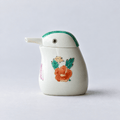
| Arita Sparrow Soy Sauce Dispenser | A bird-shaped addition for a table where the small details matter. | See the dispenser |
Choose a piece you will reach for often, then build around it. Browse our Arita ware collection, or ask our team for help choosing if you would like to compare size, finish or care requirements before ordering.
Continue the workshop story
Go back to how porcelain stone becomes Arita clay, then follow the next stage inside an Arita kiln, where porcelain is painted, glazed and fired.
Our thanks to the workshop for letting us walk the floor and photograph their work. The image we kept from the day was a simple one: a man carrying a board of plates on his shoulder, steady as a waiter, past molds that someone else carved and toward a kiln where someone else will paint them. Arita porcelain is the work of a whole town, and this is the part of it you rarely get to see.
Explore our Arita ware collection
Sources and author
This article draws on observations, photographs and video from our June 2026 visit to a forming workshop in Yamauchi, Takeo, which shapes pieces for Arita kilns. General production information is supported by the sources below. Methods and firing schedules vary; the workshop visit is not a claim that every Arita maker works in the same way.
- Arita Tourism Association: how Arita ware is made (Japanese). Regional guidance on specialist production, forming, firing, decoration and shrinkage.
- Time & Style: Arita (English). A firsthand account from a company working with Arita artisans, describing plaster-mold slip casting, draining, trimming and drying.
- Noritake: plaster molds for ceramic casting (Japanese). Technical background on pressure-assisted casting with specialist plaster molds.

Written by Erika
Head of Procurement at My Japanese World
Erika leads procurement at My Japanese World. Read about Erika, our team and how we select Japanese craft. For questions about a piece featured here, contact our team.
Frequently asked questions
How is porcelain made, step by step?
The broad sequence is body preparation, forming, drying and firing. For much blue-and-white Arita ware, a first bisque firing is followed by underglaze painting, glazing and the main firing. Overglaze decoration requires further firing. The exact sequence depends on the finish.
What is slip casting?
Slip casting is a way of shaping ceramics with liquid clay. The slip is poured into a plaster mold, which absorbs water from it so that a layer of clay builds up on the mold's inner surface. In drain casting, excess slip is poured out once the wall has reached the required thickness. The piece is removed when firm enough, then trimmed and dried. Time & Style describes this process in its Arita production account.
What is the difference between slip casting and pressure casting?
In ordinary slip casting, the slip fills the mold by gravity. In pressure casting, it is forced into the molds under pressure, often into a stack of molds at once. Arita uses pressure casting for square, oval and irregular plates.
What is jiggering in pottery?
Jiggering shapes plastic clay against a rotating mold with a profile tool, commonly for plates. The related process for hollow forms such as bowls is called jolleying. Both belong to machine-assisted wheel forming and produce rotationally symmetrical forms at that stage.
Is slip-cast porcelain handmade?
Slip-cast porcelain can involve substantial handwork, including mold handling, trimming and decoration. The amount varies by workshop and level of mechanization. “Slip-cast,” “hand-finished,” “hand-painted” and “hand-thrown” describe different things; check which applies to the piece you are buying.
Why do pieces in a porcelain set vary slightly in size?
Drying and firing cause shrinkage, and finished dimensions can vary slightly even when pieces share a mold. Check the product’s stated measurements and tolerances, and ask the seller if matching dimensions are important.