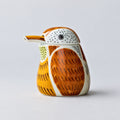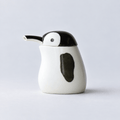



On the table, a piece of Arita porcelain can look almost effortless: a white surface, a few blue brushstrokes, a thin rim. At the clay works, you see how much has happened before a potter even touches it.
In June 2026, we spent a morning at Koda Toudo (香田陶土) in Ureshino, Saga Prefecture. In the yard were heaps of pale rock. Inside were stamp mills, tanks of milky liquid and stacks of damp clay. We followed the material from one to the next. This is where our series on how Arita ware is made begins.
What is porcelain made of?
Porcelain is made from a mineral-rich ceramic body that becomes dense and hard when fired at high temperature. A familiar recipe combines kaolin, feldspar and quartz: clay for workability, a flux that helps the body vitrify, and silica that contributes to its structure. Recipes vary between makers and types of porcelain.
In Arita, an important starting material is tōseki (陶石), or pottery stone. Amakusa stone contains quartz, sericite, kaolinite and a small amount of feldspar. The useful minerals are already present in the rock. After careful processing, it can form a porcelain body without a separately blended three-ingredient recipe.
That does not mean every Arita maker uses exactly the same formula. It means that the stone itself can supply the body. Koda Toudo describes this property in its guide to Amakusa pottery stone and its clays.
| Stage | A blended porcelain body | The pottery-stone body we followed |
|---|---|---|
| Starting material | Typically kaolin, feldspar and quartz | Selected Amakusa pottery stone |
| Preparation | Ingredients measured and mixed to a recipe | Stone cleaned, crushed and refined in water |
| Before shaping | A prepared body suited to the forming method | Filter-pressed clay, then further prepared for casting or wheel work |
| In the kiln | The body vitrifies at its intended firing temperature | The refined stone body vitrifies into porcelain |
So yes, porcelain is made from a clay body. In this workshop, that body begins as hard rock. Crushing does not create new clay minerals; it releases and refines the minerals already there. Porcelain is also a type of ceramic, rather than a separate material category. Our porcelain and ceramic guide explains the distinction.
Where Arita's porcelain stone comes from
Arita's porcelain story begins at Izumiyama. Local tradition credits a Korean potter known in Japan as Kanagae Sanbei, or Ri Sampei, with finding pottery stone there in the early 1600s. That discovery helped make large-scale porcelain production possible in Japan. The Nabeshima rulers of Saga guarded access to this valuable resource.
Izumiyama was designated a National Historic Site in 1980 and was actively quarried until about 1995. By the late 1800s, Arita kilns had begun buying stone from Amakusa in Kumamoto Prefecture. Today, most Arita ware uses Amakusa stone, according to the Japan Tourism Agency's history of Izumiyama Quarry.
For more on the kilns, export trade and decoration that followed, see our introduction to Arita ware.

Inside Koda Toudo, a clay maker near Arita
A potter does not necessarily start at the quarry. Specialist clay makers do the work between the raw stone and the forming workshop. Koda Toudo has been making porcelain clay in Ureshino since 1889. Its company history describes five generations supplying kilns and ceramic artists in Arita, Hasami, Imari and the wider Hizen region.
Outside, the contrast between the stones was striking. Some were almost white; others carried yellow, orange and dark bands. Below the company sign, the pale broken surfaces and rusty stains sat side by side. The sign gives the founding year as Meiji 22: 1889.

The seven stages below follow the workshop's process, from selected stone to clay ready for a potter. The details matter: much of this work will disappear from view in the finished plate.
From stone to porcelain clay in seven steps
1. Sorting, washing and removing iron-stained material
For a clean white porcelain body, the first task is choosing and cleaning the stone. Iron-bearing material can discolor the fired body or leave dark specks, so workers wash away mud and chip off stained areas with a hammer.
Koda Toudo calls the hammer work migaki, or polishing. Here, polishing means removing unwanted material, one piece at a time. The yellow, banded stone our guide held made the reason easy to see.

2. Crushing the stone
The cleaned stone passes through a crusher and comes out in pieces about 3–5 cm across, roughly 1–2 inches. It still looks like gravel. Nothing about it suggests a teacup yet.
3. Pounding it in a stamp mill
Next comes the stamp mill. Heavy pestles repeatedly strike the broken stone in large mortar-like containers. Koda Toudo gives about 13 hours for this stage: a long stretch of pounding to turn the pieces into powder.

The gears and machinery are dusted white. Once the powder is fine enough, it is carried by air to a storage hopper. Koda Toudo has kept this traditional stamping method as part of its approach to making clay.

4. Mixing with water and separating coarse particles
A conveyor carries the powder to a mixer, where it is dispersed in water. The stone does not literally dissolve like sugar. Its fine particles form a suspension, while coarser stone and sand are separated out.
The milky mixture is called deishō, or slip. Watching it pour from the scoops, it is hard to connect it with the rocks outside. The refined suspension is collected in tanks for the next stages.

5. Reducing fine iron and sieving the slip
Hand-cleaning deals with visible staining. An electromagnetic separator helps remove finer iron-bearing particles. A vibrating sieve, with openings of about 75 microns, screens out remaining oversized particles and impurities before the slip enters a finishing tank.
A white body depends on more than one step. The starting stone, its low iron and titanium content, careful refining, and the firing conditions all play a part. Refining reduces unwanted material; it does not remove every trace of iron.
6. Pressing out the water
The slip is pumped into a filter press: a row of cloth-lined plates held together under pressure. Water passes through the cloth, leaving damp clay between the plates.

When the press opens, the clay comes out in flat, cream-colored slabs. Each has a mark at the center where the slip entered. Stacked together, they look a little like sheets of pastry.

This is a prepared clay material, but the next step depends on how a workshop will shape its pieces. For slip casting, clay must be made into a fluid casting slip with controlled water content and flow. A solid slab is not poured directly into a mold.
7. Preparing clay in the vacuum pug mill
For wheel work, the slabs pass through a vacuum pug mill. It kneads the clay, removes trapped air and adjusts its consistency so a potter has an even body to work with.
The clay emerges as a smooth cylinder, is wrapped to keep it moist and is stacked for delivery. On one of the top bags was the handwritten label 特上, tokujō: top grade. After all the sorting, hammering and filtering, the material is finally recognizable as something you could put on a wheel.

The kiln will make the next transformation. Koda Toudo lists 1,260–1,300°C (about 2,300–2,370°F) for several of its porcelain clays, although the right firing schedule depends on the body. During firing, the body vitrifies and develops the density and hardness associated with porcelain.
What this work means for the piece on your table
The clay maker's work is easy to overlook because a finished piece gives so little of it away. But it helps explain several things you can see and feel:
- A clean ground for decoration. A carefully prepared pale body lets cobalt-blue brushwork stand out.
- The possibility of fine walls. A suitable body and skilled forming allow delicate shapes, while correct firing develops strength. Thin porcelain still needs care.
- A dense fired body. Well-vitrified porcelain has low water absorption. Glaze, decoration and the maker's instructions still determine how a particular piece should be used and washed.
- Small variations. A dark speck can come from an iron-bearing inclusion, but appearance alone cannot establish its cause or whether a piece is a second.
Our guide to caring for ceramic dishes covers everyday washing and storage.
The Shochiku-Bai Square Plate from Daikei Kiln is an example of how a white porcelain ground frames blue hand-painted decoration. Its square shape leaves room for the brushwork as well as the food.

The Blue Tokusa Flower Oblong Plate from Fukuizumi Kiln gives that contrast a longer shape for sushi, small dishes or dessert.

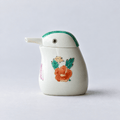
Other pieces take porcelain in a different direction. Our Arita B&W cups and marble rice bowls bring darker patterns to the table. Kouraku Kiln's Kingfisher soy sauce dispenser turns the body into a small sculptural form.
These are examples of finished Arita ware in our collection. We have not established that their makers use clay supplied by Koda Toudo.


Arita, Hasami and Imari: shared materials, different traditions
A clay maker can supply several pottery towns. Koda Toudo works with makers across the Hizen region, and Amakusa stone is used beyond Arita. The name on a finished piece therefore tells you about more than its mineral ingredients: place, workshop practice, forming and decoration matter too.
Arita has a long tradition of painted porcelain. Imari is closely associated with the export trade and the decorative wares shipped through its port. Hasami ware has its own history of porcelain for everyday use. There is variety within each tradition, as our guide to Japanese pottery styles shows.
The series: how Arita ware is made
This visit follows the material up to the point where forming can begin. The next parts of the series will look at:
- Shaping: wheel throwing, jiggering and casting in plaster molds.
- Blue and white: bisque firing and cobalt decoration, known as sometsuke.
- Glaze and fire: glazing and the high firing. Our guide to Japanese kilns gives some background.
- Color and gold: overglaze decoration and the additional firings it requires.
Thank you to everyone at Koda Toudo for welcoming us into the works. Back at the table, it is the handwork at the beginning that stays with us: someone turning a stone, finding the stain and deciding what to remove. A finished plate carries that work even when you can no longer see it.
Explore our Arita ware collection
Sources and author
This article draws on our June 2026 workshop visit, supported by Koda Toudo's published manufacturing process, clay specifications and company history, and the Japan Tourism Agency's Izumiyama Quarry history.

Written by Erika
Head of Procurement at My Japanese World
Meet Erika and the team on our About Us page.
Frequently asked questions
What is Arita porcelain made of?
Much of today's Arita porcelain begins with Amakusa pottery stone from Kumamoto Prefecture. This mineral-rich rock is selected, crushed, refined in water and prepared as a ceramic body before shaping and firing. Individual clay recipes can vary.
Is porcelain made from clay or stone?
Porcelain is formed from a prepared ceramic body. Many bodies blend clay with other minerals; the pottery-stone body described here starts with rock that already contains clay minerals. Crushing and refining make that material usable for forming.
Does Arita porcelain contain kaolin?
Amakusa pottery stone contains kaolinite, the principal clay mineral in kaolin, alongside quartz, sericite and some feldspar. A stone-based body need not have kaolin added as a separate ingredient.
Why is Arita porcelain white?
The color depends on the raw material, refining, glaze and firing. Amakusa stone is valued for its low iron and titanium content. Removing stained stone and reducing impurities helps produce a clean, pale body.
Does Arita still use stone from Izumiyama?
Izumiyama is Arita's historic source and was actively quarried until about 1995. Most modern Arita ware uses Amakusa stone. Izumiyama remains an important historic site, rather than the main source described in this article.
What causes a black speck in porcelain?
A small dark speck can be an iron-bearing inclusion that darkened during firing, although there are other possible causes. Its appearance alone does not determine the piece's grade or condition. Ask the maker or seller if you are unsure about a mark.