This site uses cookies for better user experience and analytics.
Kutani Aochibu Sakura Incense Burner
$140.00
No reviews
No reviews yet · Customers rate us 4.9/5 (48 reviews) · Read them
Porcelain · 5.5 × 5.5 × 9.6 cm · Made in Japan · Wooden box
In stock
Ships within 4 business days
Secure, insured delivery from Japan
Complimentary over $199 · otherwise from $30. Shipping policy
$59 away from complimentary shipping
U.S. duties prepaid at checkout
Import duties and taxes are calculated and paid at checkout, so nothing is due on delivery. Learn more
Sourced in Japan, from the makers
Direct from Japanese workshops and their authorised channels.
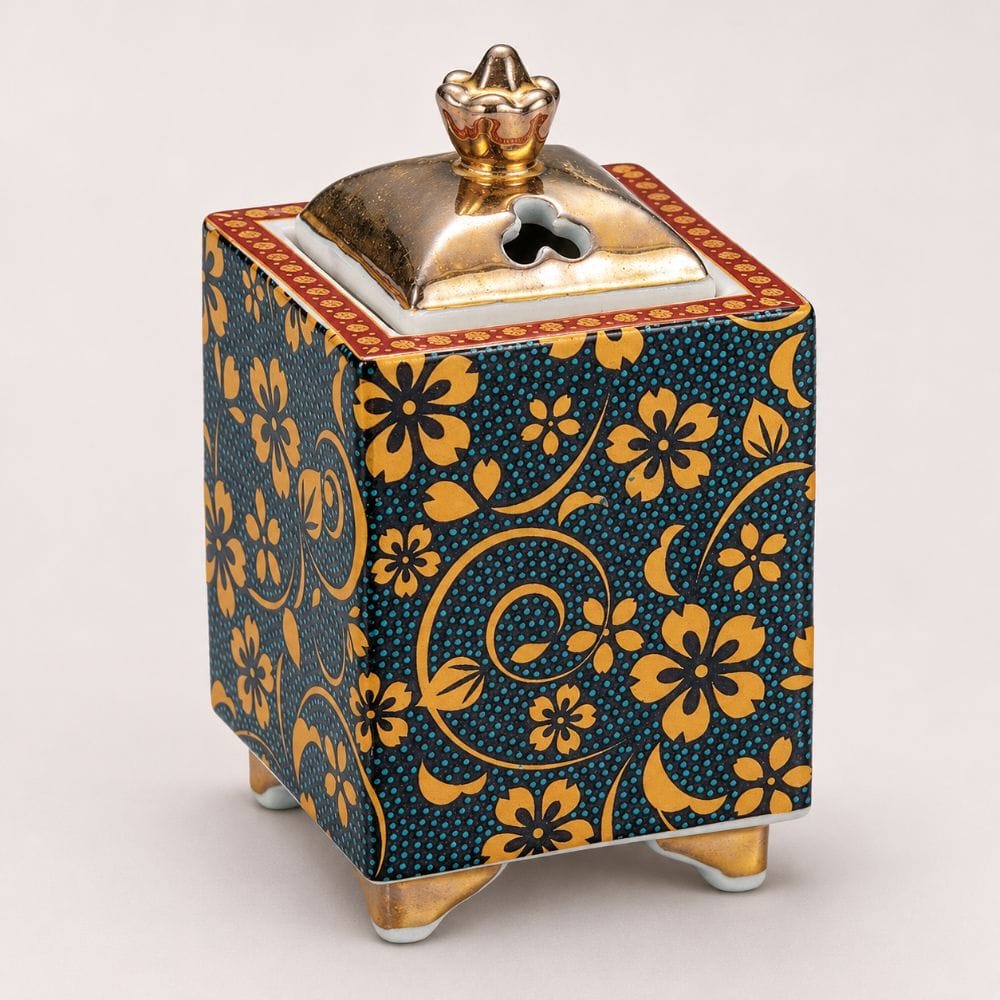
Cherry blossoms in gold, a quiet richness in blue. Fine raised Aochibu dots create a textured setting for the floral decoration on this compact Kutani porcelain burner. Made in Japan and presented in a wooden box, it brings considered detail to an incense ritual or a carefully arranged display.
Why You’ll Love It
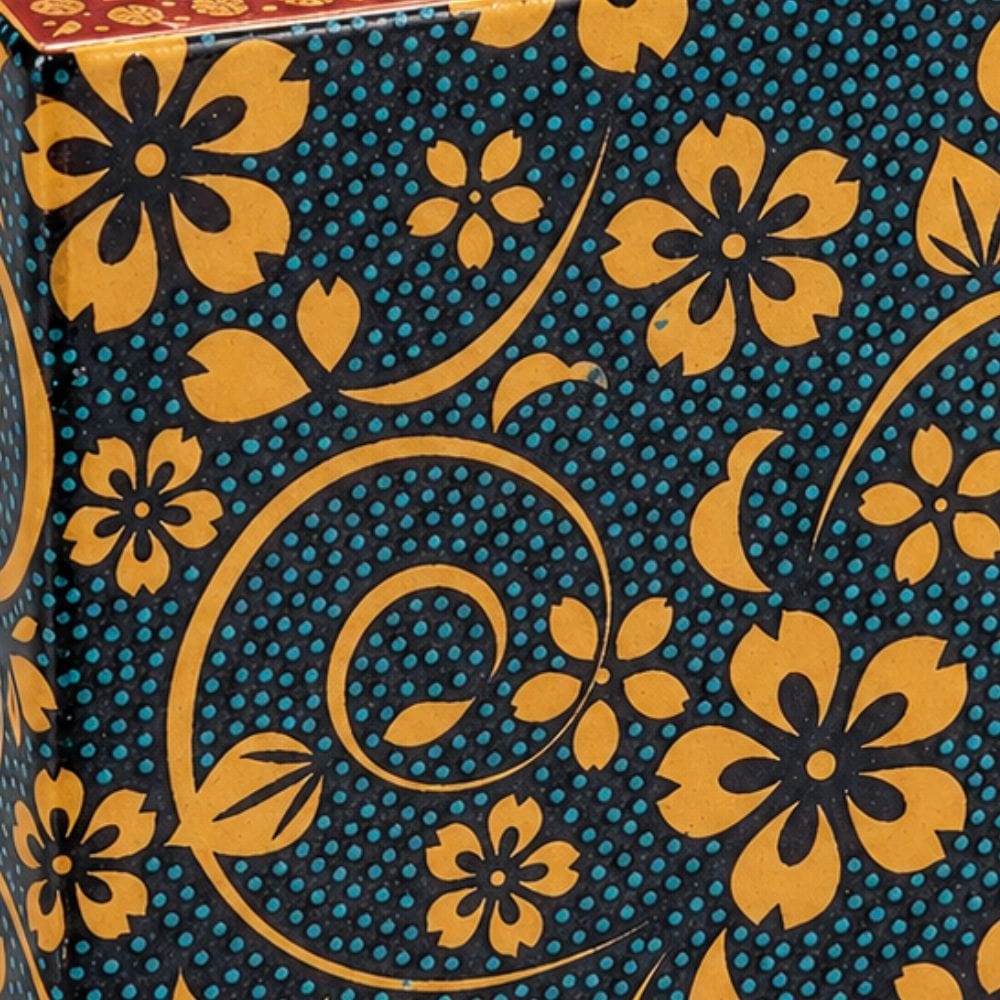
Fine raised Aochibu dots give the porcelain surface depth and texture
Gold-toned cherry blossoms stand out against the richly coloured ground
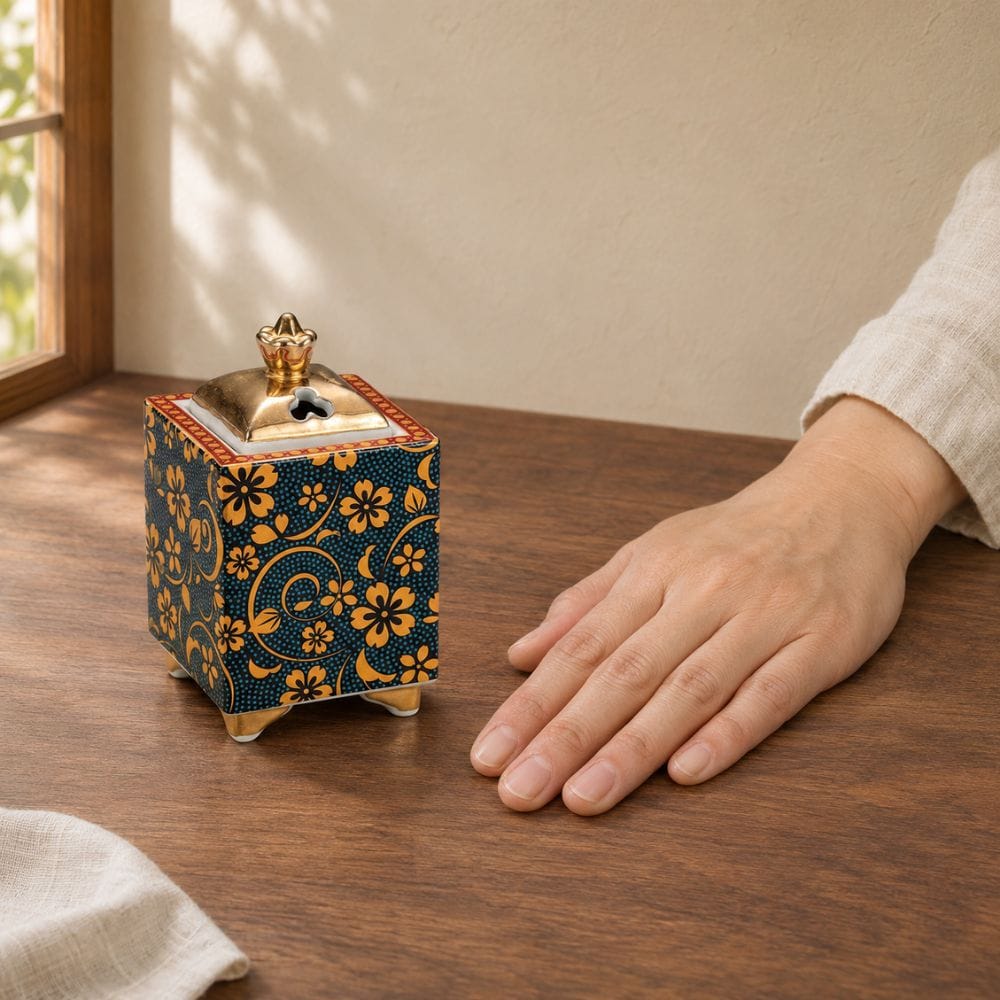
A compact square form, approximately 5.5 cm per side × 9.6 cm high
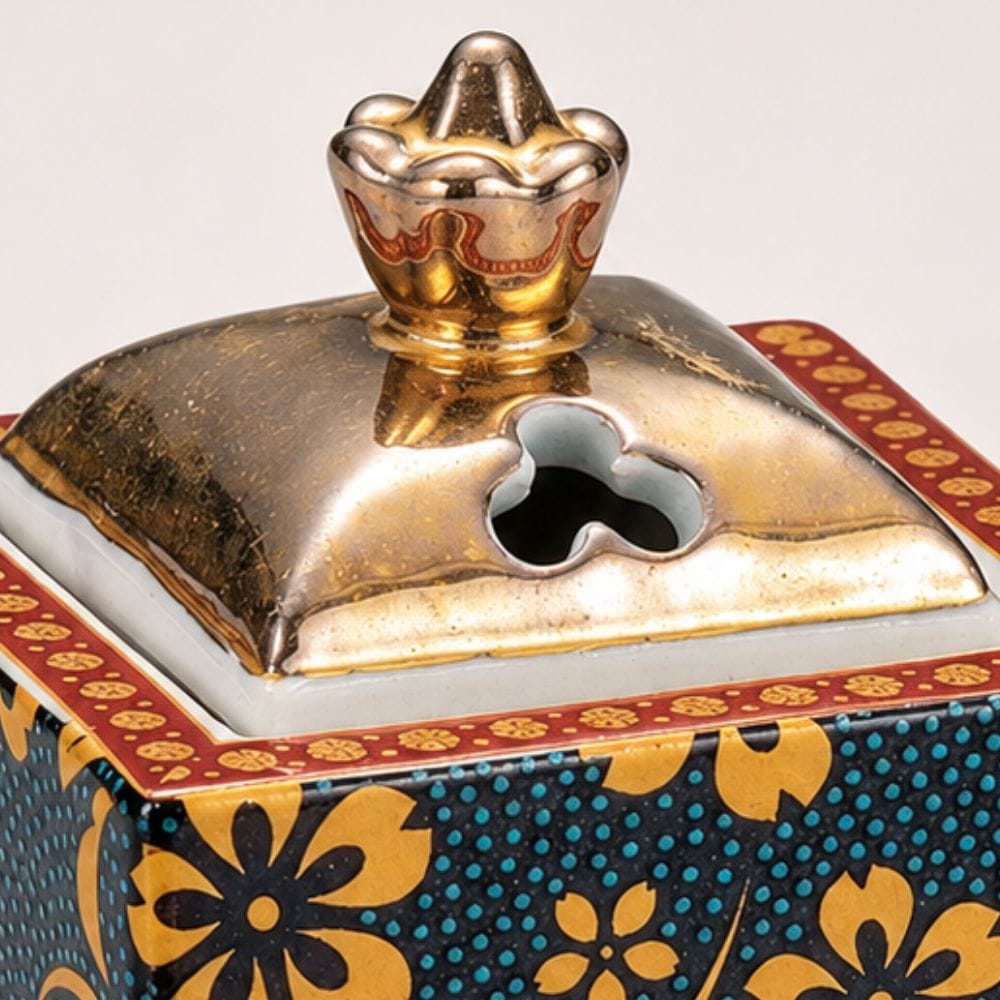
Gold-toned cherry blossoms unfold across a richly coloured, finely dotted ground on this square Kutani porcelain incense burner. The contrast between the flowing floral design and the ordered texture gives the small piece a striking decorative presence.
The raised-dot decoration, known as Aochibu, rewards a closer look. Closely spaced dots add relief and visual depth to the porcelain surface, creating an intricate backdrop for the larger blossoms. Its square body gives the floral composition a clear, architectural frame.
Made in Japan, the burner measures approximately 5.5 cm per side and 9.6 cm high (2.2 × 3.8 in). Its compact proportions suit a personal incense ritual, while the richly detailed surface remains a pleasure to appreciate on a shelf, console, or in a display cabinet between uses.
Presented in a wooden box, it makes a considered gift for an incense enthusiast or someone drawn to the colour and precision of Japanese ceramics.
Product Information
Item: Kutani ware incense burner
Design: Aochibu Sakura (blue-dot cherry blossom)
Decoration: Raised Aochibu dots with gold-toned floral detail
Allow the burner to cool completely before handling or cleaning. Carefully remove loose ash and dust the exterior with a soft, dry cloth. Avoid abrasive pads, harsh cleaners, and soaking. Do not place in a dishwasher or microwave.
When burning incense, place the burner on a stable, heat-resistant surface with clear space around it. Keep it away from flammable materials, children, and pets, and never leave burning incense unattended. Follow the instructions supplied with your incense and burner.
Artisan & Craft
Kutani ware is a Japanese ceramic tradition associated with Ishikawa Prefecture, celebrated for its richly decorated surfaces. Aochibu decoration became widespread during the Taishō period (1912–1926). Tiny raised dots are arranged across a coloured ground; consistency in their size, colour, and spacing gives the technique its distinctive rhythm. On this piece, that finely textured surface provides a rich setting for the cherry blossoms.
Note
Pattern placement, colour shading, and dimensions may vary slightly between pieces. The item you receive may differ subtly from the photographs.
Questions About This Piece
What is Aochibu decoration?
Aochibu is Kutani decoration made with fine raised dots across a coloured ground. Their closely spaced arrangement creates a textured surface that sets off the larger cherry blossom motifs. Keeping the dots consistent in size, colour, and spacing requires precise decorative skill.
How large is this incense burner?
Its square exterior measures approximately 5.5 × 5.5 cm, with a height of 9.6 cm (2.2 × 2.2 × 3.8 in). The interior space for incense is smaller. Its compact form can be enjoyed on a shelf or console between uses.
Does it come in a presentation box?
Yes. One porcelain incense burner is presented in a wooden box, making it a thoughtful gift for someone who enjoys incense or Japanese ceramics.
Will every piece look exactly the same?
Pattern placement, colour shading, and dimensions may vary slightly from piece to piece. The photographs show the design; your burner may differ subtly in these small details.
Kutani ware · Ishikawa, Japan
Kutani: Japan’s art of brilliant color
Kutani ware emerged in Ishikawa in the 17th century and became
celebrated for bold overglaze painting and an unmistakably rich use
of color. Its decorative language ranges from expressive nature motifs
to highly detailed compositions, giving Kutani porcelain a vivid
character unlike almost any other Japanese ceramic tradition.
17th-century rootsborn in Ishikawa
Kutani Gosaifive signature colors
Overglaze paintingbold, layered, expressive
Ishikawa · Hokuriku · Japan
Discover Kutani
Learn more about Kutani ware
What is Kutani ware?
Kutani ware is a tradition of Japanese porcelain associated with
Ishikawa Prefecture. It first developed in the 17th century and is
especially known for richly colored overglaze decoration, bold
compositions and a wide range of styles that evolved over several
centuries.
What are the five colors of Kutani ware?
The traditional Kutani palette is often referred to as Kutani Gosai,
or the five Kutani colors: red, yellow, green, purple and dark blue.
These vivid overglaze enamels are used in different combinations,
from dense decorative painting to more restrained contemporary work.
Where is Kutani ware made?
Kutani ware is associated with Ishikawa Prefecture in Japan’s
Hokuriku region, particularly the areas around Kaga, Komatsu and
Kanazawa. The original Kutani production began near present-day
Kaga in the mid-1600s.
Why does Kutani ware look so different from other Japanese porcelain?
Kutani is distinguished by its emphasis on decoration after the
porcelain body has been fired. Layers of colored enamel are applied
over the glaze, allowing artists to create saturated color, strong
outlines and highly expressive imagery. This gives Kutani ware a
more painterly and often more dramatic appearance than many other
Japanese porcelain traditions.
Choosing a selection results in a full page refresh.