This site uses cookies for better user experience and analytics.
Sangiri Bizen Ware Sake Set – Toho Kiln
$119.00
No reviews
4.9/5 store rating · 48 customer reviews ·
Read them
Toho Kiln · Bizen ware · 420 ml flask + 65 ml cup · Made in Japan
In stock
Ships within 4 business days
Secure, insured delivery from Japan
Complimentary over $199 · otherwise from $30. Shipping policy
$80 away from complimentary shipping
U.S. duties prepaid at checkout
Import duties and taxes are calculated and paid at checkout, so nothing is due on delivery. Learn more
Sourced in Japan, from the makers
Direct from Japanese workshops and their authorised channels.
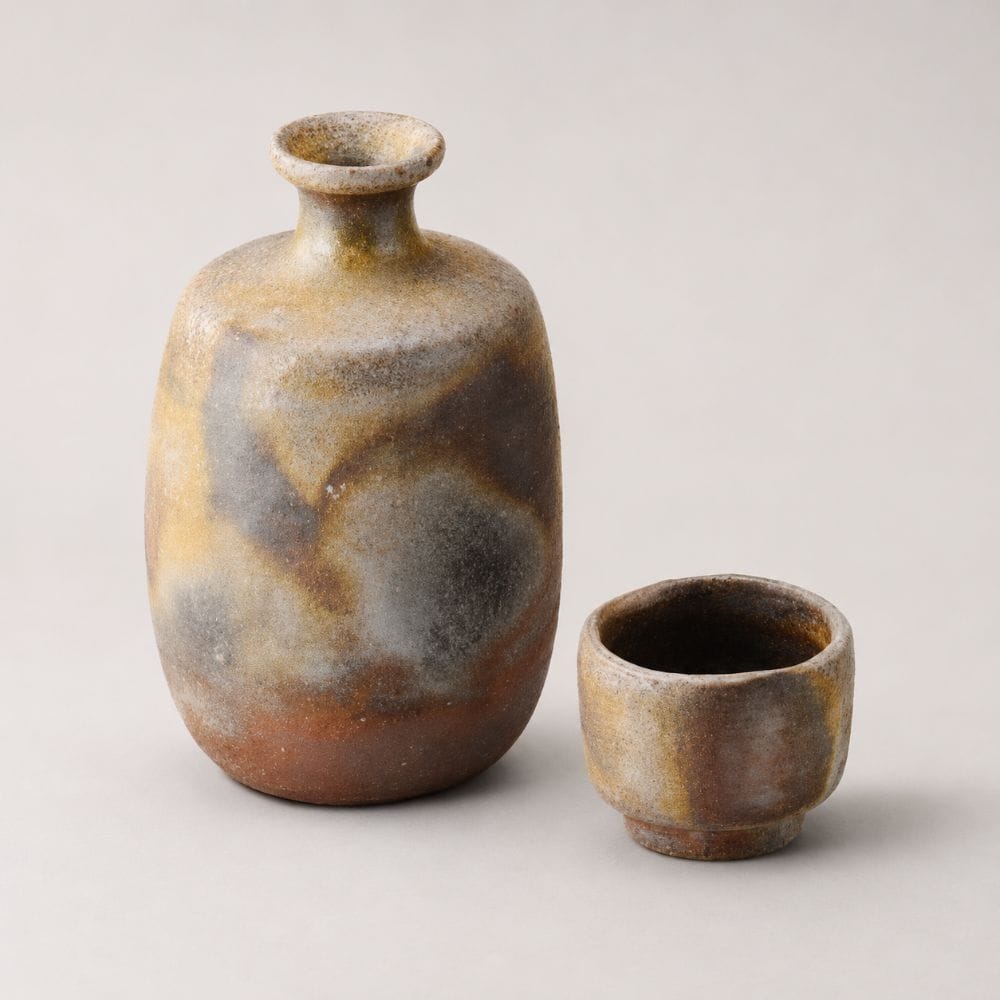
A 420 ml sake flask and one 65 ml cup from Toho Kiln, with the warm, smoky contrasts of Sangiri Bizen ware. Presented in a wooden box for gifting or enjoying at your own table.
Why You’ll Love It
420 ml flask and one 65 ml cup — a compact set for serving sake
Sangiri firing marks vary from piece to piece
Warm clay tones and a tactile, unglazed Bizen surface
A rounded tokkuri sake flask and one matching cup, with warm brown clay and smoky areas of grey: this Sangiri Bizen Ware Sake Set from Toho Kiln brings the character of Japanese pottery to the sake table. The flask holds approximately 420 ml, while the 65 ml cup is sized for small pours.
The finish is created during firing. Known as Sangiri (桟切), these contrasts develop in strongly reducing conditions, where ash, embers or charcoal affect the ceramic surface. The marks are part of the fired clay rather than a printed pattern, and their placement varies from piece to piece.
Bizen ware comes from Okayama Prefecture and is traditionally fired without an applied decorative glaze. Here, the simple flask and open cup keep the clay’s colour and texture in view. Pour a little at a time and enjoy the feel of the cup between sips.
Presented in a wooden box, the two-piece set makes a considered gift for a sake enthusiast or an addition to your own table. It includes one flask and one cup; sake is not included.
Craft: Bizen ware (Bizen-yaki), Okayama Prefecture
Material: Pottery
Finish: Sangiri (桟切), with colour variations developed during firing
Set contents: 1 sake flask (tokkuri) and 1 sake cup
Flask size: Approx. 3.3 in across × 5.3 in H (8.5 × 13.5 cm)
Flask capacity: Approx. 14.2 US fl oz / 420 ml
Cup size: Approx. 2.4 in diameter × 1.8 in H (6 × 4.5 cm)
Cup capacity: Approx. 2.2 US fl oz / 65 ml
Packaging: Wooden presentation box
Country of manufacture: Japan
Care instructions
We recommend washing by hand with mild dish soap and a soft sponge. Rinse well and allow both pieces to dry thoroughly before storing.
Avoid abrasive cleaners, prolonged soaking and sudden changes in temperature. Do not place the flask over a direct flame. Keep the wooden box dry.
Artisan & Craft
This set is made by Toho Kiln (陶峰窯) in Japan and finished in Sangiri, a Bizen firing technique. Reducing conditions around the work draw out contrasting colours across the ceramic surface; potters can encourage this effect through the placement of the pieces and the use of charcoal.
Bizen ware is associated with Okayama Prefecture. Its long tradition of unglazed pottery places particular importance on the clay, the loading of the kiln and the changes that take place during firing. In this set, those variations provide the decoration.
Note
Sangiri firing creates variations in colour and the placement of surface markings. The photographs show an example; your set’s pattern may differ. Dimensions and capacities are approximate. Includes one flask, one cup and a wooden box. Sake is not included.
Questions About This Piece
What is included, and how much does each piece hold?
The set includes one sake flask (tokkuri), one sake cup and a wooden presentation box. The flask holds approximately 420 ml (14.2 US fl oz), and the cup holds approximately 65 ml (2.2 US fl oz). Sake is not included.
Will my set look exactly like the photographs?
The overall form and Sangiri finish will be similar, but the distribution of warm and smoky tones varies during firing. The photographs show an example of the set rather than an identical pattern on every piece.
How should I clean and care for the sake set?
We recommend hand washing with mild dish soap and a soft sponge, then drying thoroughly before storage. Avoid abrasive cleaners, prolonged soaking, sudden temperature changes and direct flame. Keep the wooden presentation box dry.
BIZEN WARE · OKAYAMA, JAPAN
Toho Kiln The character of Sangiri
The appeal of Toho Kiln’s Sangiri Bizen ware lies in the surface itself: warm clay tones interrupted by darker, smoky areas. These contrasts develop during firing, rather than being painted onto the finished vessel. The Japanese name for the kiln is 陶峰窯.
Sangiri, written 桟切, is a firing effect produced in a strongly reducing atmosphere. It can develop where a vessel is sheltered by ash or embers; potters can also encourage it by introducing charcoal around the work towards the end of firing. The way each piece meets these conditions gives the surface its particular balance of colour.
This attention to the fired clay is central to Bizen ware, the ceramic tradition of Okayama. Traditionally made without an applied decorative glaze, Bizen places the material and the firing at the centre of the design. In a sake vessel, the result is something to appreciate close at hand: a simple form with a surface that changes as you turn it.
Toho Kiln陶峰窯 · Bizen ware
Sangiri · 桟切Colour developed during firing
Made in JapanPottery for serving sake
Bizen ware · 備前焼 · Okayama Prefecture · Japan
UNDERSTANDING BIZEN WARE
The clay, the firing and the finish
What is Sangiri Bizen ware?
Sangiri is the name of a Bizen firing effect, rather than a painted pattern or a separate clay type. Strongly reducing conditions change the colour of areas of the ceramic surface, creating contrasts that can include smoky grey and dark tones alongside the warmer colour of the clay.
Is Sangiri entirely accidental?
No. Potters can encourage Sangiri through the placement of the work and the use of charcoal. The final pattern still depends on the conditions around each vessel during firing. The maker’s decisions and the behaviour of the kiln both contribute to the result.
Does “unglazed” mean there can be no glossy areas?
No. Traditional Bizen ware is fired without an applied decorative glaze, but wood ash can melt onto the clay and form a natural ash glaze. The speckled effect known as goma takes its name from its resemblance to sesame seeds. Goma and Sangiri are different firing effects; they should not be treated as interchangeable names for the same finish.
Why can the colour vary from one piece to another?
A vessel’s position and its exposure to heat, ash and the firing atmosphere influence its surface. The distribution of warm and dark tones can therefore vary between pieces. Product photographs show an example of the finish; the precise placement of the firing marks is not a repeated printed design.
Choosing a selection results in a full page refresh.