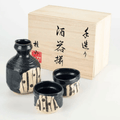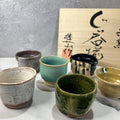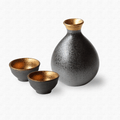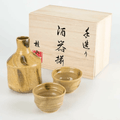



Order warm sake at an izakaya in Japan and it usually arrives in a small ceramic flask with a narrow neck. That flask is a tokkuri. It is the center of almost every Japanese sake set, and it does more than pour: it is the vessel you warm the sake in, the measure you order by, and often the most decorated piece on the table.
This guide explains what a tokkuri is, where it came from, how it differs from a katakuchi or chirori, what sizes mean, how to warm sake in one at home, and what to look for when you choose one.
What is a tokkuri?
A tokkuri (徳利) is a Japanese sake flask: a rounded body that narrows to a slim neck, used to serve sake at the table, warm or chilled. You pour from it into small cups such as ochoko or the slightly larger guinomi. In English it is also called a sake flask, sake bottle or sake carafe.
The name is usually explained as an imitation of the sound sake makes as it leaves the neck, tokuri tokuri, something like "glug glug" in English. That is the most common explanation, not a certainty. The sound itself is part of the pleasure: a mouth narrow enough to gurgle, but wide enough to pour smoothly, is what a good tokkuri aims for. Some novelty flasks, known as uguisu tokkuri (warbler tokkuri), are even made to sing like a bird when sake is poured.
A short history: from storage jar to table flask
Before glass bottles, a tokkuri was a general-purpose container. Narrow-necked ceramic flasks held soy sauce and vinegar as well as sake. From the Edo period into the early Showa era, sake shops sold sake by measure, and customers carried it home in a tokkuri, sometimes one lent by the shop. The Mihara City Museum of History and Folklore in Hiroshima describes flasks of this kind, most often holding one shō (1.8 liters), with smaller and larger sizes also made.
Warming sake in a tokkuri at the table came later. According to food historian Aoki Naoki, until late in the Edo period sake was usually heated either in a metal pot and transferred to a handled choshi, or in a metal chirori set in hot water and poured straight into the cup. The small warming flask, kan-dokkuri (燗徳利), appears in sources from around the Bunsei and early Tenpō eras, roughly the 1820s to early 1830s. By the Meiji era, a round-bodied, tall-necked warming flask, the kampin tokkuri, was a popular shape.
Today the tokkuri is simply the standard sake server in homes and restaurants across Japan, made in porcelain, stoneware, glass and metal.
Tokkuri, katakuchi and chirori: what is the difference?
Japanese has several words for the vessel between the sake bottle and the cup. They are easy to mix up, so here is how they compare.
| Vessel | Shape | Typical use |
|---|---|---|
| Tokkuri (徳利) | Rounded body, narrow neck | Serving warm or chilled sake; the flask is warmed in a hot water bath |
| Katakuchi (片口) | Open bowl or jug with a pouring lip | Serving sake, often chilled or at room temperature; the open top releases aroma |
| Chirori (銚釐) | Metal cup-shaped warmer with a handle and spout | Warming sake quickly in hot water; still used in some oden bars and traditional restaurants |
| Choshi (銚子) | Originally a long-handled pouring vessel | Ceremonial pouring; today the word is also used loosely for a tokkuri |
For the cup side of the set, see our guide to sake cup sizes and types. Our guide to sake carafes looks at glass and other modern servers.

Don't be fooled by the shape of the bottle. These three bottles contain one gō despite their different shapes.
Tokkuri sizes: what one gō means
Sake in Japan is still measured in gō (合). One gō is about 180 ml, or roughly 6 fl oz. When you order "one tokkuri" in a restaurant, it is usually a one-gō or two-gō flask. Much larger flasks exist, up to one shō (10 gō, 1.8 liters) and beyond, but those were for buying and storing sake. At the table, flasks of up to two gō are the sizes you will see most often.
| Size | Capacity | Good for |
|---|---|---|
| 1 gō | About 180 ml / 6 fl oz | One person, or a first round for two |
| 1.5 gō | About 270 ml / 9 fl oz | Two people sharing |
| 2 gō | About 360 ml / 12 fl oz | Two to four people |
The tokkuri in our sets range from about 250 ml (8.5 fl oz) to 420 ml (14 fl oz). Remember that you should not fill a flask to the brim, especially when warming, so the usable amount is a little less than the stated capacity.
Cups are small by design, typically about 1 to 3.5 fl oz (30 to 100 ml). You pour little and often, and by custom you pour for each other rather than for yourself. Our guide on how to drink sake covers the etiquette.
How to warm sake in a tokkuri
Warmed sake is called kanzake (燗酒), or okan. The traditional method, and still the best one at home, is a hot water bath, called yusen.
- Fill the tokkuri with sake, leaving some space below the neck.
- Heat water in a pan until it is close to boiling, then turn off the heat.
- Stand the tokkuri in the water so the water comes up to about the level of the sake.
- Check after a few minutes. Touch the base of the flask, or use a kitchen thermometer, and take it out when it reaches the warmth you like.
- Dry the outside of the flask and serve straight away.
Japanese has a name for each step of warmth. You do not need to know them all, but they are a useful guide to how far to go.
| Name | Meaning | Approximate temperature |
|---|---|---|
| Hinata-kan (日向燗) | Sunshine warm | 30°C / 86°F |
| Hitohada-kan (人肌燗) | Skin warm | 35°C / 95°F |
| Nuru-kan (ぬる燗) | Lukewarm | 40°C / 104°F |
| Jō-kan (上燗) | Nicely warm | 45°C / 113°F |
| Atsu-kan (熱燗) | Hot | 50°C / 122°F |
| Tobikiri-kan (飛び切り燗) | Piping hot | 55°C / 131°F and above |
As a rough guide from the Kikusui brewery: at nuru-kan the flask feels warm but not hot to the touch; at atsu-kan steam rises and the flask is hot in the hand. Nuru-kan is a gentle place to start. Not every sake suits warming, so check what the brewer suggests.
Can you warm sake in a tokkuri in the microwave? Only if the maker says the piece is microwave safe. Never microwave a tokkuri with gold, silver or other metallic decoration. Microwaving can also heat unevenly, which is one more reason a water bath is the traditional choice.
Can you use a tokkuri for chilled sake?
Yes. A tokkuri works at any temperature, and ceramic flasks are often used for room-temperature and chilled sake as well as warm. Chill the sake rather than the flask if you are unsure whether a piece suits the fridge. Glass tokkuri are a popular choice for chilled sake.
How to choose a tokkuri
1. Material and ware
Material changes how a tokkuri looks, feels and is cared for.
- Porcelain is smooth, non-porous and easy to clean. It is the base for painted wares such as Kutani ware from Ishikawa, with its bold overglaze colors, and Hasami ware from Nagasaki.
- Glazed stoneware has more weight and texture. Mino ware from Gifu includes the Oribe (often copper green, or black in Black Oribe), Shino and Kiseto (yellow Seto) styles.
- Unglazed stoneware such as Bizen ware from Okayama is wood-fired without an applied decorative glaze, so the color comes from the clay and the kiln. It needs a little more care when drying.
- Glass is light and best for chilled sake.
2. Size
Think about how many people usually share it. A flask of about 250 to 300 ml (8.5 to 10 fl oz) suits two people well. Choose 350 ml (12 fl oz) or more if you entertain, or if you like to warm one flask and refill cups without getting up.
3. Neck and pour
A narrow neck is the classic form and makes the gurgling pour. A wider mouth pours faster and is easier to clean and dry. If you can, check how the flask feels when full: a good tokkuri is stable on the table and easy to hold by the neck or shoulder.
4. Decoration and care
Painted and gold-decorated pieces are the most striking, and usually need hand washing. If you want something for every day, look for a set the maker describes as dishwasher or microwave safe.
5. Cups and tray
Most tokkuri are sold as a set with two cups. Some sets add a tray, which keeps drips off the table and makes a set look finished as a gift. Sets with a single cup suit ohitorisama, a Japanese term for someone who enjoys going out or dining on their own.
Six tokkuri sets from our collection
These sets show the range of shapes, wares and sizes described above. Capacities are from our product pages. Browse the full Japanese sake sets collection for more.
For texture and the color of the fire: Bizen
The Sangiri Bizen Ware Sake Set from Toho Kiln has a rounded flask of about 420 ml (14 fl oz), our largest here, with one 65 ml cup. Its grey and brown sangiri markings form in the kiln, so no two sets are the same. It comes in a wooden box.

For bold glaze: Black Oribe
The Black Oribe Mino Sake Set by Keizan Kiln, made in Toki, Gifu, pairs a glossy black glaze with white decoration. The 255 ml (8.6 fl oz) tokkuri and two 95 ml (3.2 fl oz) cups are sized for two.

For warm, golden glaze: Kiseto
The Handmade Kiseto Sake Set is wheel-thrown Mino ware in the soft yellow Kiseto glaze. The 300 ml (10 fl oz) tokkuri stands 11 cm (4.3 in) tall, with two cups, in a calligraphy-marked wooden box.

For color and a tray: Kutani
The Kutani Rabbits Sake Set is porcelain from Ishikawa, decorated with rabbits, with a 260 ml (8.8 fl oz) tokkuri, two cups and a matching tray.

For a larger painted flask: Kutani Tea Flower
The Kutani Tea Flower Sake Set has hand-painted floral decoration in strong Kutani colors, and a larger 350 ml (12 fl oz) tokkuri for sharing.

For a low, wide pourer: Hasami
The Nadeshiko Hasami Sake Set takes a different form: a low, wide pourer holding up to 250 ml (8.5 fl oz) with a 100 ml (3.4 fl oz) cup, in durable Hasami porcelain from Nagasaki. It also works for tea.

How to clean and care for a tokkuri
A narrow neck makes a tokkuri a little harder to clean than a cup, but the routine is simple.
- Rinse soon after use with warm water, so sake does not dry inside.
- Use a bottle brush and a little mild detergent if needed, then rinse well.
- Dry upside down and let the inside dry completely before you put it away. This matters most for unglazed pieces such as Bizen.
- Follow the maker's instructions for the dishwasher and microwave. Hand washing is the safe choice for painted, gold-decorated and lustre pieces.
Our ceramic care guide covers washing and storage in more detail.
Sources and author
This guide was checked against the following sources:
- Mihara City Museum of History and Folklore, newsletter No. 59 (Japanese PDF), on tokkuri used to buy and carry sake.
- Aoki Naoki, Edo umaimono saijiki (Bunshun excerpt, Japanese), on chirori and the appearance of the kan-dokkuri.
- University of Idaho Library, Japanese ceramics glossary: kampin tokkuri, citing Cort (2000).
- Edo-Tokyo Museum collection: one-gō tokkuri (about 180 ml).
- Kikusui Sake Co.: How to enjoy sake and Nippon.com, on warm sake temperatures.
- Japan Tourism Agency multilingual commentary database (PDF), on uguisu tokkuri.
- Government of Japan, Highlighting Japan (April 2025), on sake vessels.

Written by Kazumi Taguchi
Customer Support, My Japanese World
Kazumi joins our visits to makers in Japan and helps customers with choosing and caring for their pieces. Meet the team on our About Us page.
Frequently asked questions
What is a tokkuri?
A tokkuri is a Japanese sake flask with a rounded body and a narrow neck. It is used to serve sake at the table, warm or chilled, and is usually sold with small cups called ochoko or guinomi.
How do you pronounce tokkuri?
Say it "tok-koo-ree", with a short pause on the double k. In combinations the first sound can change, as in kan-dokkuri, a warming flask.
How much sake does a tokkuri hold?
Most hold one or two gō. One gō is about 180 ml (6 fl oz), so a two-gō tokkuri holds about 360 ml (12 fl oz). The flasks in our sets hold about 250 to 420 ml (8.5 to 14 fl oz).
What is the difference between a tokkuri and a katakuchi?
A tokkuri is a flask with a narrow neck. A katakuchi is an open bowl or jug with a pouring lip. Both serve sake, but the tokkuri is the usual choice for warming.
How do you warm sake in a tokkuri?
Stand the filled tokkuri in a pan of water that has just come off the boil, check it after a few minutes, and take it out at the warmth you like. Nuru-kan, about 40°C (104°F), is a good place to start.
Can you put a tokkuri in the microwave?
Only if the maker says the piece is microwave safe, and never if it has gold, silver or other metallic decoration. A hot water bath heats more evenly.
Can you use a tokkuri for cold sake?
Yes. A tokkuri works for chilled, room-temperature and warm sake. Glass tokkuri are a popular choice for chilled sake.