This site uses cookies for better user experience and analytics.
Silver Camellia Kutani Sake Set – Green
$129.00
No reviews
No reviews yet · Customers rate us 4.9/5 (47 reviews) · Read them
1 flask + 2 cups • 350 ml flask • Kutani ware • Made in Japan
In stock
Ships within 4 business days
Secure, insured delivery from Japan
Complimentary over $199 · otherwise from $30. Shipping policy
$70 away from complimentary shipping
U.S. duties prepaid at checkout
Import duties and taxes are calculated and paid at checkout, so nothing is due on delivery. Learn more
Sourced in Japan, from the makers
Direct from Japanese workshops and their authorised channels.
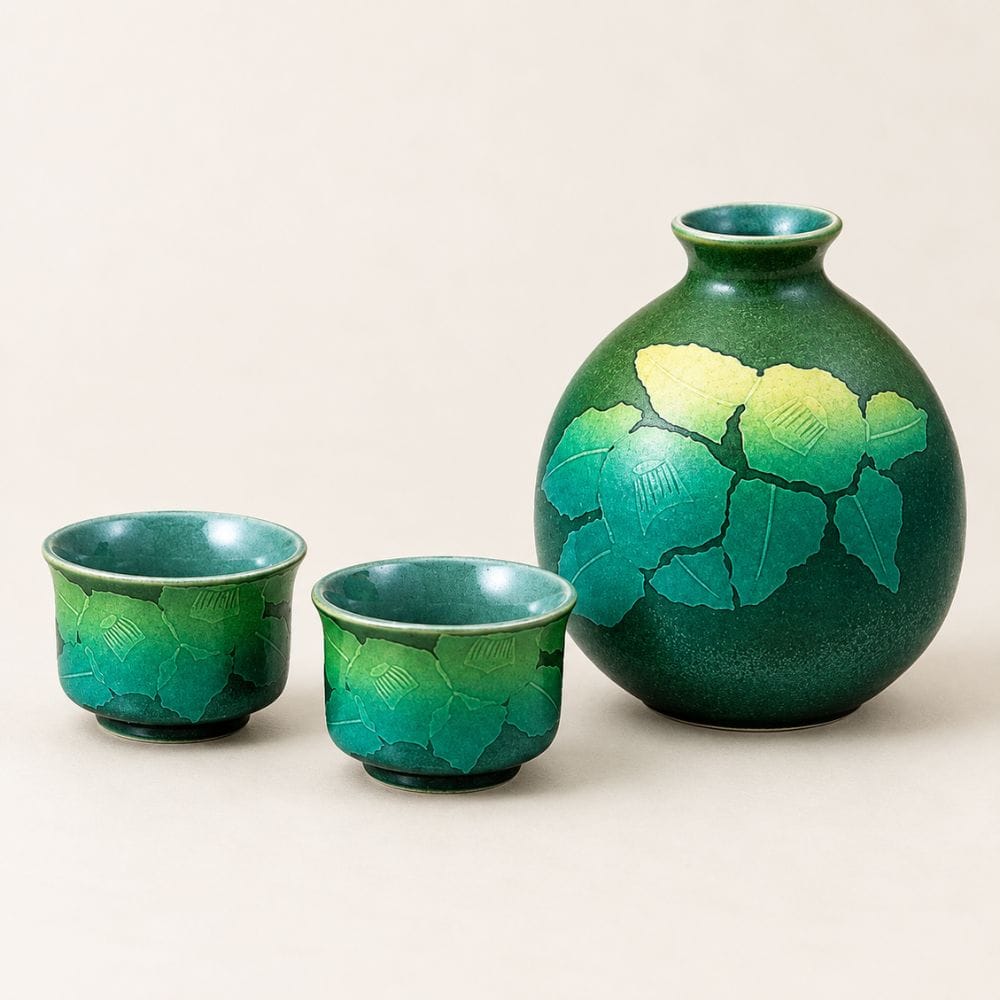
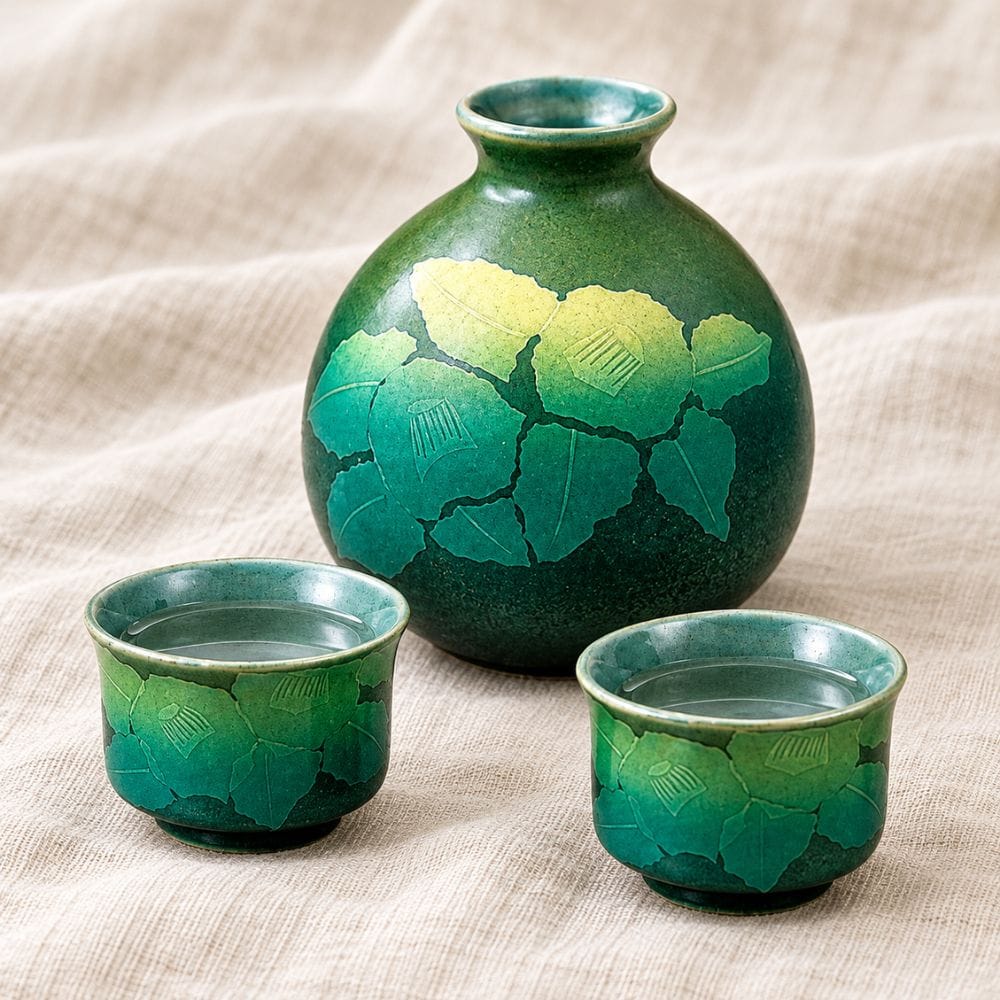
Emerald and pale yellow-green flowers catch the light against a richly shaded green ground. The rounded flask and gently flared cups repeat the same floral design, creating a coordinated setting that feels equally at home at a dinner table or on a small serving tray.
Why You’ll Love It
A complete three-piece set: one sake flask and two matching cups.
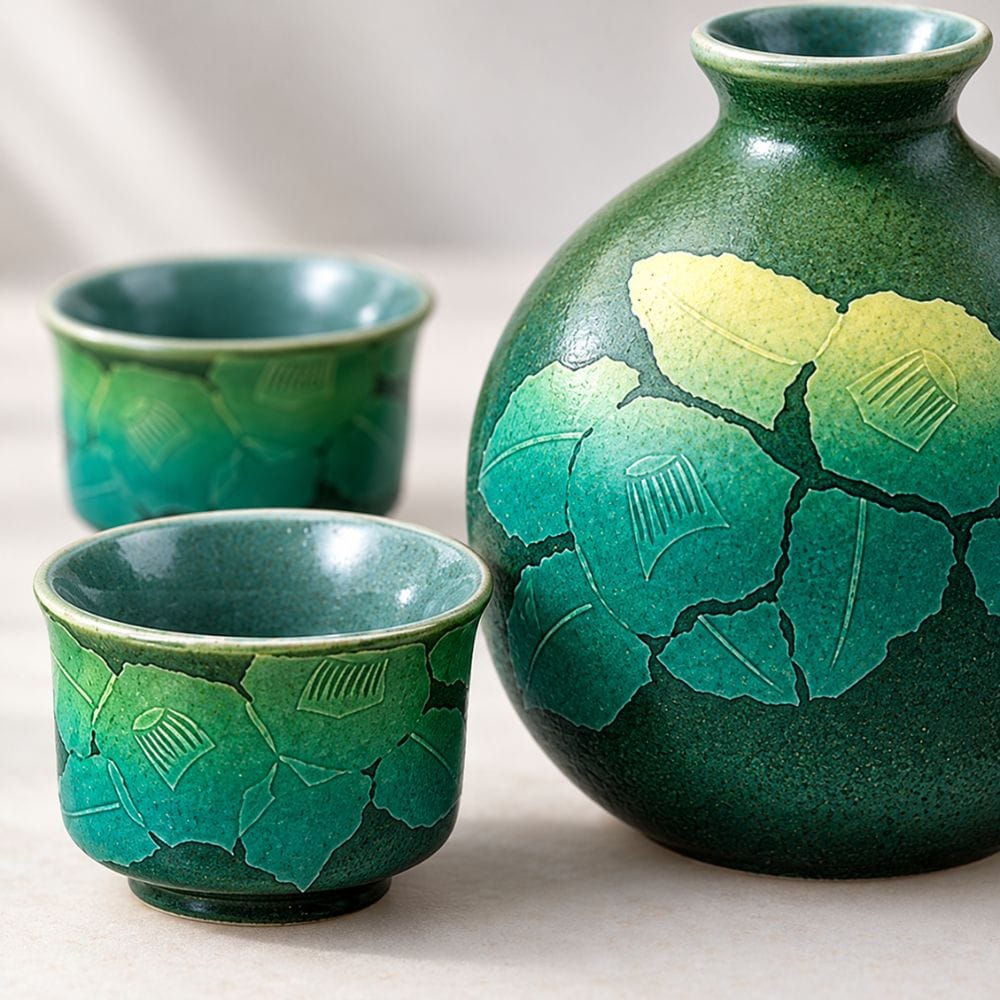
Sasanqua camellia decoration brings luminous colour to the deep green surface.
350 ml flask capacity suits small pours shared over a meal.
Luminous camellia blossoms emerge from a deep green ground, shifting from emerald to pale yellow-green across the rounded flask and two matching cups. The design, known as Gin Sazanka or silver camellia, brings a quiet richness to an evening sake setting.
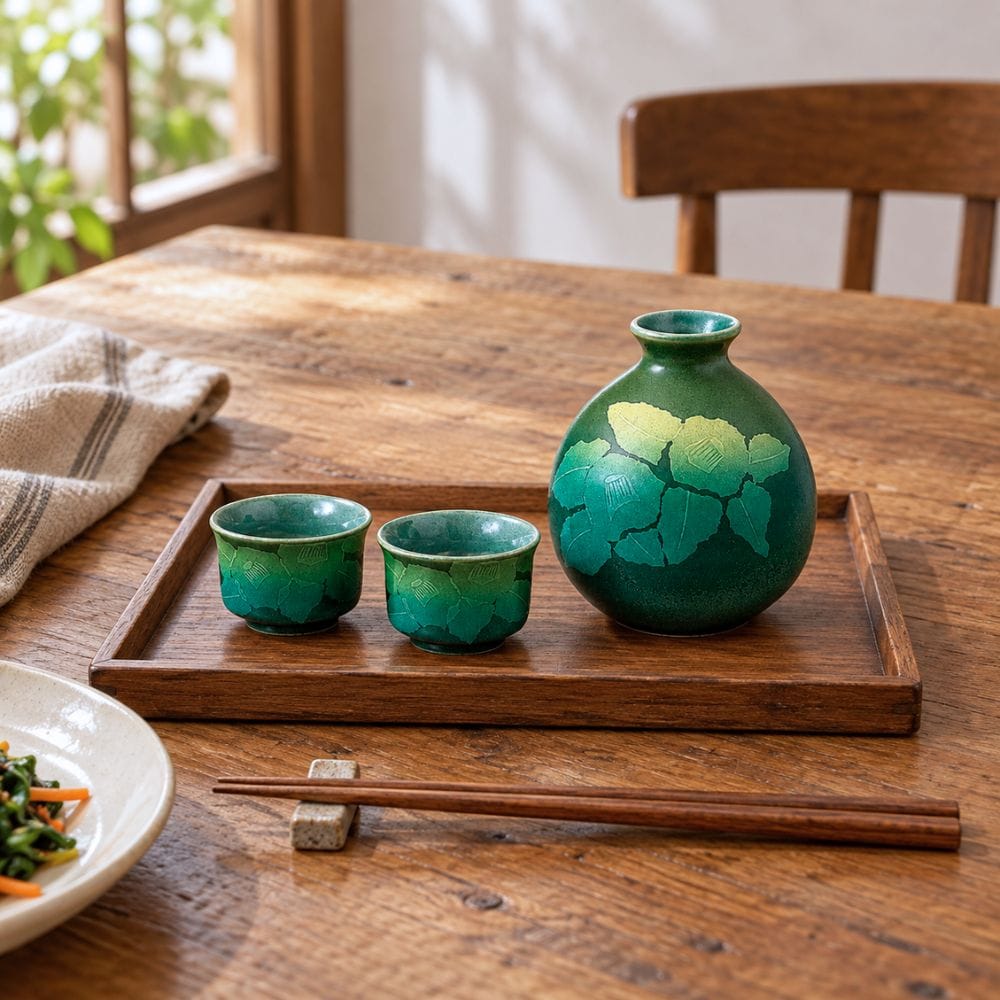
The flask has a gently rounded body, a narrow neck and a flared lip. Its 350 ml capacity is well suited to small pours shared over dinner, while the two compact cups echo its floral decoration. Set the three pieces on a simple wooden tray or alongside understated tableware to let the green tones stand out.
Made in Japan from ceramic, this Kutani set combines a distinctive floral surface with a practical three-piece serving format. Each cup measures 5.5 cm in diameter and 4 cm high, a small scale for sipping and refilling throughout a meal.
Presented in a gift box, it is a considered choice for a wedding, a housewarming or a sake enthusiast. The set includes one flask and two cups.
Product Information
Contents: One sake flask (tokkuri) and two sake cups
Design: Gin Sazanka — silver camellia
Craft: Kutani ware
Material: Ceramic
Flask capacity: 350 ml / approximately 11.8 US fl oz
Cup dimensions: Diameter 5.5 cm × height 4 cm / approximately 2.2 × 1.6 in
Origin: Japan
Packaging: Presentation box
Care instructions
Hand wash with a soft sponge and mild detergent. Rinse thoroughly and allow the flask to dry completely inside before storing.
Do not use in the microwave or dishwasher. Avoid abrasive cleaners, direct heat, impacts and sudden temperature changes. For warm sake, heat it separately in a suitable vessel before serving.
Artisan & Craft
Made in Japan, this set offers a restrained expression of Kutani ware through a deep green palette and luminous floral decoration. The design is called Gin Sazanka, or silver camellia, and carries the same blossom motif across the flask and both cups.
Note
Includes one flask and two cups. The 350 ml capacity refers to the flask; cup capacity is not specified. Allow space below the rim when filling.
Questions About This Piece
What is included in the set?
The set includes one 350 ml sake flask and two matching cups, presented together in a gift box.
What does Gin Sazanka mean?
Gin Sazanka means silver camellia. The design depicts sasanqua camellia blossoms in luminous green and pale yellow-green tones against a deep green ground.
Can I heat sake in the flask?
Do not put the flask or cups in a microwave or over direct heat. For warm sake, heat it separately in a suitable vessel before serving, and avoid sudden temperature changes. Hand wash all three pieces; do not use a dishwasher.
Would this make a suitable gift?
Yes. With a coordinated flask and two cups in a presentation box, it makes a thoughtful gift for a couple, a host or someone who enjoys Japanese ceramics and sake.
Kutani ware · Ishikawa, Japan
Kutani: Japan’s art of brilliant color
Kutani ware emerged in Ishikawa in the 17th century and became
celebrated for bold overglaze painting and an unmistakably rich use
of color. Its decorative language ranges from expressive nature motifs
to highly detailed compositions, giving Kutani porcelain a vivid
character unlike almost any other Japanese ceramic tradition.
17th-century rootsborn in Ishikawa
Kutani Gosaifive signature colors
Overglaze paintingbold, layered, expressive
Ishikawa · Hokuriku · Japan
Discover Kutani
Learn more about Kutani ware
What is Kutani ware?
Kutani ware is a tradition of Japanese porcelain associated with
Ishikawa Prefecture. It first developed in the 17th century and is
especially known for richly colored overglaze decoration, bold
compositions and a wide range of styles that evolved over several
centuries.
What are the five colors of Kutani ware?
The traditional Kutani palette is often referred to as Kutani Gosai,
or the five Kutani colors: red, yellow, green, purple and dark blue.
These vivid overglaze enamels are used in different combinations,
from dense decorative painting to more restrained contemporary work.
Where is Kutani ware made?
Kutani ware is associated with Ishikawa Prefecture in Japan’s
Hokuriku region, particularly the areas around Kaga, Komatsu and
Kanazawa. The original Kutani production began near present-day
Kaga in the mid-1600s.
Why does Kutani ware look so different from other Japanese porcelain?
Kutani is distinguished by its emphasis on decoration after the
porcelain body has been fired. Layers of colored enamel are applied
over the glaze, allowing artists to create saturated color, strong
outlines and highly expressive imagery. This gives Kutani ware a
more painterly and often more dramatic appearance than many other
Japanese porcelain traditions.
Choosing a selection results in a full page refresh.