This site uses cookies for better user experience and analytics.
Gold and Silver Otsumami Cup Pair
$49.00
1 review
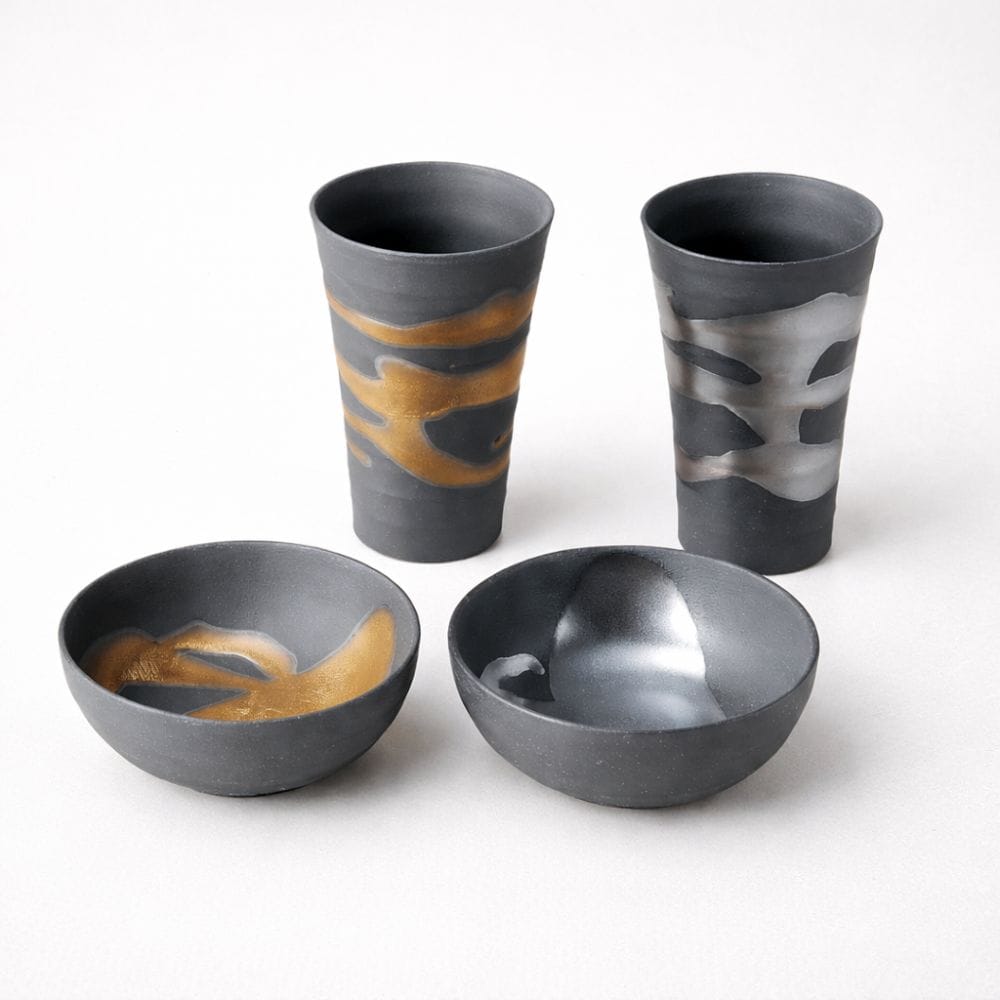
Set of 2 cups + 2 bowls • Ceramic with metallic glaze • 150cc (5 oz) • Made in Japan
In stock
Ships within 4 business days
Secure, insured delivery from Japan
Worldwide shipping from $30 · free over $150. Shipping policy
$49 of $150 with this item · $101 to go
U.S. duties prepaid
No extra import charges on delivery — the price you see is the price you pay. Learn more
Sourced in Japan, from the makers
Direct from Japanese workshops and their authorised channels.
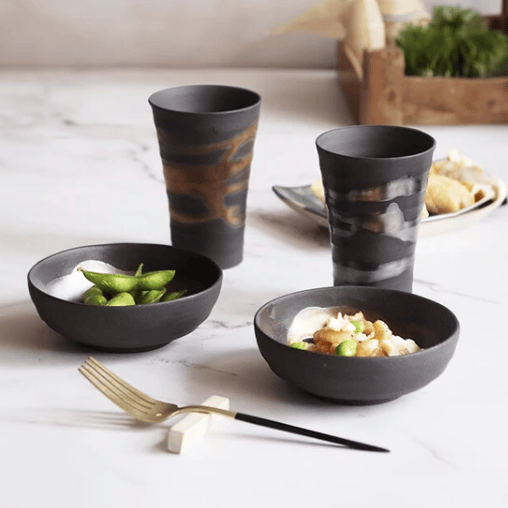
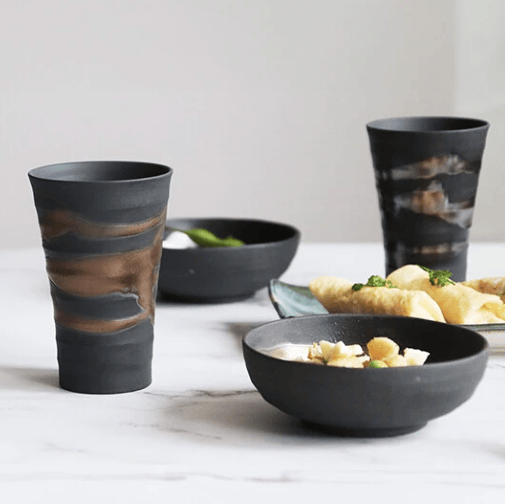
Serve chilled sake, plum wine, or a small digestif in the Gold and Silver Otsumami Cup Pair. The two matching bowls are sized for otsumami, condiments, or small desserts, while the matte black body and gold-and-silver glaze accents create a distinct look at the table. Handcrafted in Japan by Kinsho Kiln.
Why You’ll Love It
Includes 2 cups and 2 small bowls for drinks and small bites.
Cup capacity is 5.07 fl oz (150 ml), a comfortable size for chilled sake or plum wine.
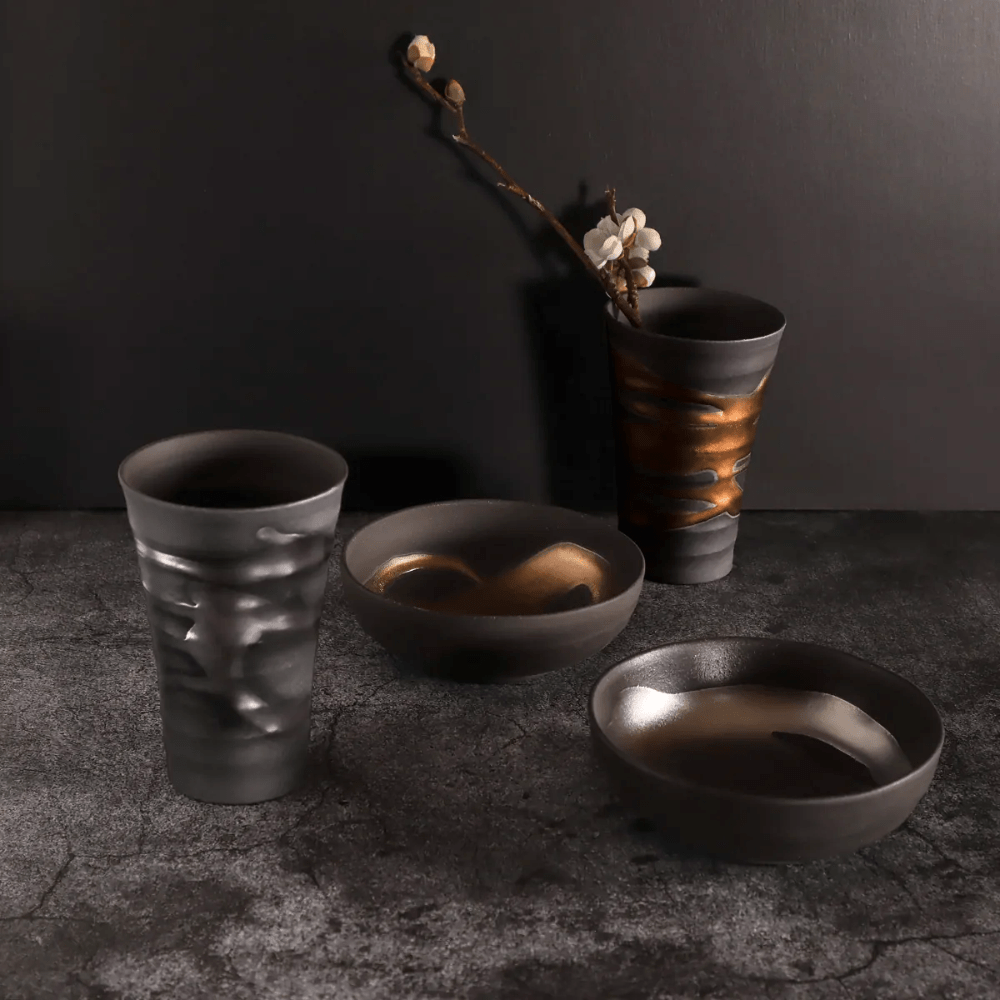
Matte black porcelain with gold and silver glaze accents gives each piece a different look.
Handcrafted in Japan by Kinsho Kiln.
Hand wash only, so the glaze finish can be handled with care.
A Gold & Silver Pair That Honors Craft and Contrast
Product Description
The Gold and Silver Otsumami Cup Pair brings together two cups and two small bowls in a balanced set for drinks and small servings. The cups are sized for chilled sake, plum wine, or a digestif, while the bowls suit otsumami, condiments, or dessert portions.
Each piece has a matte black body with gold and silver glaze accents. The glaze is applied by hand, so the finish has natural variation from piece to piece.
Handcrafted in Japan by Kinsho Kiln, this set includes 2 cups and 2 small bowls. The cups hold 5.07 fl oz (150 ml), measure 2.76" (7 cm) in diameter by 2.36" (6 cm) in height, and the bowls measure 3.54" (9 cm) in diameter by 1.57" (4 cm) in height.
Hand wash only. Not microwave or dishwasher safe. Handle with care to protect the glaze.
Product Information
Set includes: 2 cups, 2 small bowls
Cup capacity: 5.07 fl oz (150 ml)
Cup dimensions: 2.76 in diameter × 2.36 in height (70 × 60 mm)
Bowl dimensions: 3.54 in diameter × 1.57 in height (90 × 40 mm)
Finish: Matte black body with gold and silver glaze accents
Origin: Handcrafted in Japan by Kinsho Kiln
Care instructions
- Hand wash only.
- Not microwave or dishwasher safe.
- Handle with care to protect the glaze.
Artisan & Craft
Handcrafted in Japan by Kinsho Kiln.
Note
Every piece crafted by our artisans tells a unique story.
Subtle marks, slight irregularities in shape, variations in glaze color and texture—these natural differences give each creation its own soul.
Over time, as you use your pieces, their character deepens, becoming part of your daily life and memories.
Toki 土岐 - The Heart of Minoyaki 美濃焼
Toki City, Gifu Prefecture, stands as a beacon of Japan's rich ceramic heritage, particularly renowned for its Mino ware (Minoyaki). With a history spanning over 1,300 years, this region has cultivated a profound tradition of pottery.
During the Azuchi-Momoyama period (1568–1614), Toki became a sanctuary for potters fleeing conflicts in neighboring areas, leading to the establishment of kilns that produced distinctive styles like Oribe, Shino, and Setoguro ware, each celebrated for their unique glazes and forms.
Today, Toki City remains a vibrant hub for ceramic artistry, housing numerous kilns and studios that blend time-honored techniques with contemporary designs.
Made by Shigemichi Tabata in Toki City, Japan
Mr. Tabata philosophy of excellence is resumed in the sentence which resume his life. "I want to create with clay!"
The kiln, built by the previous generation for a son who chose to carry on the family tradition, has been burning steadily for over 40 years. While honoring time-honored techniques, Mr. Tabata crafts ceramics that speak to modern life.
His guiding philosophy is simplicity—a belief that tableware should quietly enhance the dining experience without drawing attention away from the food. Each piece he creates is minimal, unembellished, and deeply intentional. Discover the quiet beauty and singular craftsmanship of pottery that can only be found here.
Made by Shigemichi Tabata in Toki City, Japan
Mr. Tabata philosophy of excellence is resumed in the sentence which resume his life. "I want to create with clay!"
The kiln, built by the previous generation for a son who chose to carry on the family tradition, has been burning steadily for over 40 years. While honoring time-honored techniques, Mr. Tabata crafts ceramics that speak to modern life.
His guiding philosophy is simplicity—a belief that tableware should quietly enhance the dining experience without drawing attention away from the food. Each piece he creates is minimal, unembellished, and deeply intentional. Discover the quiet beauty and singular craftsmanship of pottery that can only be found here.
FAQs
All you need to know about Japanese Pottery.
What types of traditional pottery are made in Japan?
Japan is home to several renowned pottery styles, including Mino ware (Gifu), Bizen ware (Okayama), Arita and Imari ware (Saga), Shigaraki ware (Shiga), and Mashiko ware (Tochigi). Each region has its own distinct materials, glazes, and firing techniques that reflect local history and aesthetics. Toki City in Gifu Prefecture is particularly renowned as the heart of Mino ware (Minoyaki)—the most widely produced pottery style in Japan.
What materials are used in artisan Japanese pottery?
Most artisan pottery in Japan is made from locally sourced clay, often mixed and refined by hand. Natural minerals and ash are used in glazes, and many pieces are wood-fired or fired in traditional climbing kilns (noborigama), producing unique surface textures and natural variations.
Are artisan Japanese pottery pieces safe for food use?
Yes. Authentic artisan pottery is made with food-safe, lead-free glazes and is carefully fired at high temperatures to ensure durability and safety. However, it's important to follow care instructions, especially for unglazed or porous ceramics.
What makes Japanese pottery different from Western ceramics?
Japanese pottery often emphasizes wabi-sabi—the beauty of imperfection—resulting in organic shapes, subtle asymmetry, and natural glazes. Unlike Western ceramics, which may prioritize uniformity, Japanese pieces often celebrate the individuality of each item, reflecting the artist's hand and the firing process.
How should I care for artisan-made Japanese pottery?
Hand-wash pottery with mild soap and avoid extreme temperature changes (like placing hot items into cold water). Some unglazed pieces may absorb moisture, so allow them to fully dry before storing. Avoid microwaves or dishwashers unless the piece is specifically labeled as safe for such use.
Do I need to season Minoyaki cups before using them?
For most Minoyaki cups, especially if they are fully glazed, seasoning is not required. However, if the cup has an unglazed interior or base, or a slightly porous finish, a simple seasoning process—known as medome—can help prevent stains, odor absorption, and hairline cracks over time.
To season a Minoyaki cup: 1. Rinse the cup gently with water (no soap). 2. Fill a bowl or pot with warm water and add a small spoonful of cooked rice or flour. 3. Submerge the cup and let it soak for 30–60 minutes. 4. Rinse again and let it air-dry completely.
This step helps fill microscopic pores in the ceramic, sealing the surface naturally and extending the life of your handcrafted piece. Always follow any care instructions provided by the maker.
Choosing a selection results in a full page refresh.